Combining my interests in German cars, international relations, and general management, I recently read the book, 1000 Days in Shanghai, by Martin Posth. The book is about Volkswagen’s initial journey to become the first international automobile manufacturing partner in China. I found several interesting themes in the book, particularly the patience and vision which the VW crew exhibited when things didn’t go as planned. When factory workers appropriated factory supplies shipped in from Germany meant for the new joint venture factory and instead used them in their own Chinese car factory, for example, Posth philosophizes (and it was probably easier doing so years later in his book than it was at the time) that when the Chinese workers saw the potential success of their new company, these kinds of behaviors would stop. Time after time, the Germans felt the Chinese violated the terms of their contract agreement while the Chinese felt the Germans weren’t living up to their word and doing what they could to improvise in a changing environment. Yet both side persevered and the VW/Audi story in China is a huge success.
Then, in a recent airplane ride, I read a brief article in the in-flight magazine that was offering advice about doing business in China. The article echoed a theme I’ve also uncovered in working with the Japanese astronomy community: the Japanese/Chinese business relation is built first on personal relationships (giri on / guanxi), then on the written agreement, whereas in the West/USA, the contract is the basis of the business relationships. The people may change, but the contract remains. Our contracts are often very detailed and precisely worded. Their contracts are broader and talk more about intentions and partnerships. We use contracts to tell us what to do when conditions change. Our Eastern partners view changing conditions as natural reasons to renegotiate the contract. Both approaches make sense, but both are fundamentally different and ripe for misunderstandings if these differences aren’t recognized up front.
So, besides knowing a bit more to expect when partnering with some of our Eastern colleagues (something increasingly common these days), this situation reminds me of another simple, obvious, yet valuable point. Any time you’re interacting with another person, whether from your own culture or one very different, it’s important to understand their environment; it’s important to state and understand each other’s expectations and assumptions. Without this understanding, there would never be a Volkswagen in China. Without this understanding, it is much harder to reach true harmony and agreement in any of your human relations.
When negotiating one international agreement, Scot remembers being frustrated while his negotiating partners complained they didn’t understand a certain passage of text. After failing at multiple attempts to figure out what wording was confusing and getting maybe just a little bit frustrated, Scot remembered that not everyone is as direct as Americans. What “we don’t understand” really meant was “we don’t like”. He could have spent all day going through the text word by word without addressing the real issue at all. With that bit understood, the problem was recognized and then fairly quickly dealt with and resolved. International negotiations are full of such fun opportunities to learn how others think.
A recent article I read about how to hire the right people for the right jobs gives a statistic attributed to the US Department of Labor that 50% of all new employees are gone within the first six months of the job. I’ve tried but failed to verify this number; I even get different answers when I try to find out what the overall average turnover rate is. So, I take this statistic with a grain of salt (although it may be true, say in the fast food world, for example), but it did get me thinking. I’ve seen a number of new hires who clearly demonstrated, within their first six months on the job, that they really weren’t going to work out, yet I’ve rarely (if ever) seen them leave, neither on their own accord or through dismissal.
While I suspect this situation is true in the business world, too, I would bet it’s more prevalent in academia and less prevalent in the highest performing institutions in and out of the real world. Correctly hiring and firing people is a difficult task. I won’t discuss hiring here, other than to say sometimes you hire the right person, but put him in the wrong job, or give her the wrong supervisor. A person underperforming in a new job may simply be in the wrong seat on the bus, to use a Good to Great analogy. I don’t have any magical means to determine if it’s the person or the position that’s wrong, so I just note it as another area where careful attention to the process and good management are again needed.
Academia – and observatories are run more like academic than commercial institutions, for better or worse – has a specific mission to train and educate. This educational mission, I believe, is one reason for the reluctance to let a new employee go who isn’t performing. Perhaps they just need more training, or more time to learn the system, goes the logic. Additionally, through the fundamental trait of academic life called tenure, people have grown accustomed to having underperformers remain on staff with nothing that can be done to move them on. This sort of tone, combined with a general desire to avoid confrontation and spend as little time as possible in managing, means poor hiring decisions are rarely actively corrected.
While I’m all for giving the right person in the wrong position a chance, there are multiple reasons why we should be more responsive to removing new employees that are simply that aren’t going to work out. First of all, keeping these employees is bad for business (remember, astronomy is a business) as they obviously won’t be performing as well as your star employees. Perhaps even more important, though, is that keeping these people on board is bad for morale and makes the rest of your staff work also less efficient – both through morale loss and having to cover for the poor job of the subpar employee. When someone is hired who clearly isn’t right for an organization (or a position), most people can tell right away; it’s not a secret held only by a few manager or HR staff. When employees see new hires with poor performance being kept on, they lose respect for managers (and HR) and lose motivation to perform at their best,seeing as how poor performance is apparently enough to stay on the job. One bad hire can lower the performance of an entire group or division. And finally, as both Jim Collins in Good to Great and Buckingham and Coffman in First, Break all the Rules say, you aren’t doing anyone – you, your organization, or the employee – any good by keeping on people who are simply not going to work out. You lose performance and the employee loses a chance to actually find employment that is a better match to his skills.
So, all this is really to say that the hiring process does not end when the new employee starts her first day on the job. Managers and HR personnel should be continually assessing employees’ performance and fit to their jobs, making corrections as necessary – and making it clear to the new hires that their evaluations don’t end when they get the job!
[4Jun10: A reader pointed out I have oversimplified things here- see the comments below for what I really meant to say and please continue the discussion, if you like.]
Like any other management decision, mistakes can be made in deciding whom to hire. The best leaders Scot has seen are those who can recognize their mistakes and correct them – whether they be in hiring or anything else. Luckily, Scot hasn’t (or so he hopes) yet been anyone’s hiring mistake.
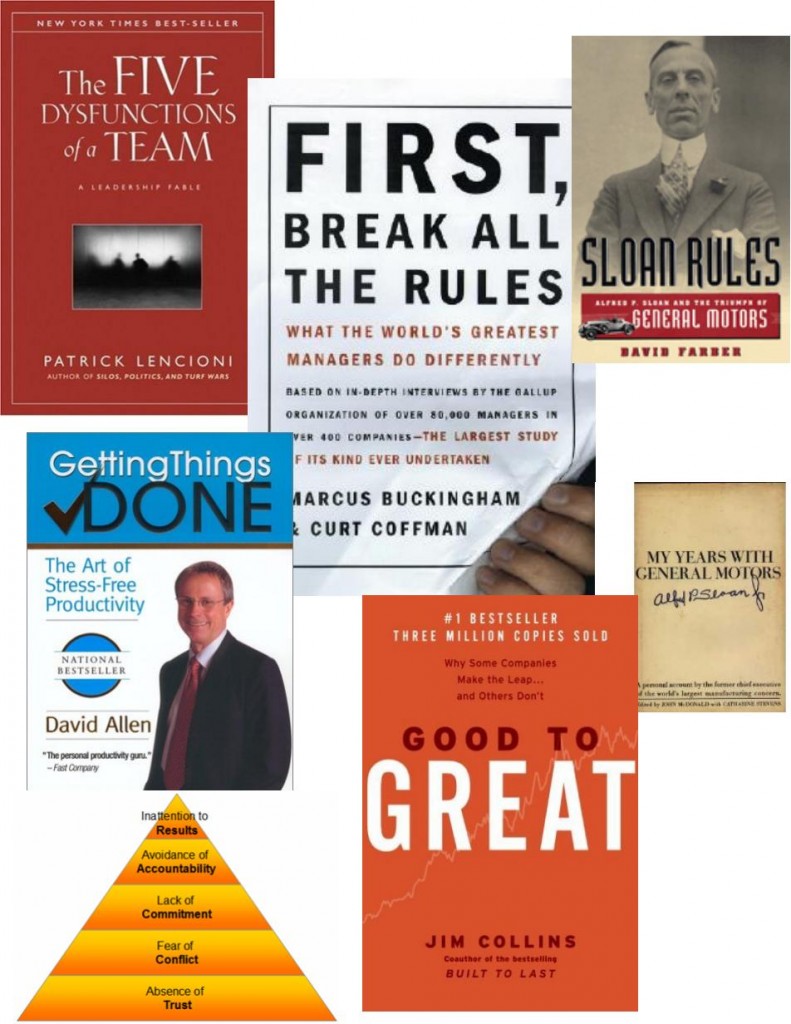
After finishing a management-related book recently, I decided to collect some notes from a few other recent readings so I could have them for easy reference. Aha – a blog post, I thought. Here, then, in roughly the order I read them, are brief summaries of what I found useful in some of my recent readings.
Sloan Rules by David Farber and My Years with General Motors by Alfred P. Sloan, Jr.: I read Sloan Rules first and got interested enough to read Sloan’s autobiography later, but if you’re not all that into it, you can just read one of them. I discuss some of the innovations Sloan brought to management in my Functional Management blog entry. Holding each division of the large and growing GM accountable for their own bottom line was one of the keys to his success with GM. Choosing and fulfilling a directed corporate strategy that would have fit the desired alignment discussed in Good to Great that provided multiple automobile lines at different price points was another key element. There are some things not to like about Sloan’s way of doing business, but there are some true innovations that later generations of management at GM moved away from to their peril. Sloan Rules gives a more objective approach to Alfred Sloan than he does himself, so I would probably recommend that one if you only want an introduction to what made GM so successful. In hindsight, it’s quite interesting to reflect on how many of his practices are recommended in the books I read later on, many of which are included in this list.
Getting Things Done by David Allen: I probably don’t need to say too much about this book, but it’s a classic book on how to organize your tasks when you have too much to do. It is simply a method designed to present to yourself, as cleanly as possible, what needs doing by when, so you can decide how to appropriate your time. I’ve adopted many of the suggested techniques and now empty my email inbox at least once per day – deploying the do, delegate or defer strategy often. As a linux and multi-computer geek, I’ve adopted the java application called gtd-free as my GTD app. and dropbox to keep it in sync on multiple machines. Google getting things done or GTD if you want more information. There are also lots of variations to this approach available on the internets as well.
Good to Great by Jim Collins: I really enjoyed this book. There is a companion manuscript available which discusses how to apply the lessons in the book to non-profit organizations and although I did read it, I really didn’t think it was necessary. The parallels are pretty obvious. The premise of the book is a study of companies that have made the transition from average to sustained greatness, trying to extract the common traits of these companies. The main points include:
Leadership that put their company ahead of their own aspirations. These leaders were typically humble, personally visible workers for the company. They were never the superstar Steve Jobs-like leaders that industry tends to flaunt.
Get the right people first, then decide where to go. You don’t want people on your bus because they like the direction you’re headed. You want the people who want results for the company and want to work with each other to choose the best direction (maybe changing their minds as they proceed) to go. First who, then what, says Collins. You need the right people on your bus, the wrong people off your bus, then you can decide how to get there.
Confront the brutal facts. To use an analogy from the book, the best companies/leaders constantly looked underneath the rocks to see what otherwise hidden dangers and industry trends awaited them. They were not afraid to confront bad news and re-assess their companies’ visions accordingly. They promoted rigorous debate. They provided an atmosphere where employees were more concerned about bringing out the lurking bad news than in how their management was going to react to it.
The best companies formed their mission by analyzing and merging into harmony what they were passionate about, what they could be the best in the world at, and what drove their economic engine. Only by aligning these three areas were these companies able to succeed at the great level.
Discipline to adhering to the mission reached as above was key to continued success. Deviations from it, new opportunities that did not fit within it, usually delivered lower results.
The good to great transitions were never the result of a single event or innovation, but rather the result of applying and rigidly adhering to these principles over time. Leaders carefully planned their own succession and set up their replacements to succeed. Superstar leaders often (secretly, perhaps) want their successors to fail so as to further highlight their own genius.
Some other ideas in the book that I took note of include:
These companies spent little time “managing change”. With the right people and environment, change largely managed itself.
To help determine who are the “right people” ask them why they made the particular life-important decisions they did.
How to know if you have a “wrong” person in a position: one way is to ask yourself if you’d be personally relieved if that person came to you and said they were leaving for a better opportunity elsewhere. Keeping the wrong people in the wrong positions does no one any good. (This theme is picked up again in the next book.) Also consider that you may have the right person, but just in the wrong seat. (I think it was Peter Drucker who said that if he promoted someone who ended up doing poorly, it was his own fault and not that of the person promoted.)
Leadership needs to create an environment where the truth can be heard and people can have their say without fear of reprisal. (Another theme elaborated on in the next book.)
The leaders of these companies spent time meeting informally with their staff- asking them what it is they need to know; what is it they should be looking at.
Learn from mistakes- and act accordingly, but remember it’s less about placing blame than it is about fixing the system.
An interesting technique used in one instance was to hand everyone in a regular meeting (or a classroom, where the technique originated) a red flag that can be used once per term. When the flag is used, the leader has to stop and give undivided attention to what the speaker has to say.
Plan budgets to allow projects either full or no funding, not in between.
Recent books I've read and found interesting.
First, Break All the Rules by Marcus Buckingham and Curt Coffman: The authors are from the Gallup Organization and using data based on extensive surveys and interviews of successful managers, they identify four primary keys for management success and, in the process, destroy some long-established management traditions. One of the first results was what employees want to be satisfied and motivated in their jobs. The list was fairly simple, but not what traditional management stresses:
To know what is expected of them.
To have the necessary materials and equipment to do their job.
To have the opportunity to do what they do best every day.
To have received praise or recognition for good work at least once per week.
To have a supervisor, or someone at work, care for them, as people.
To have someone at work encourage their development.
In summary, the most important key to an employee’s satisfaction and success at work is their immediate supervisor. This is a simple, but quite powerful concept.
The authors identify a common insight of good managers:People don’t change that much. Don’t waste time trying to put in what was left out.Try to draw out what was left in. These good managers worked hard to identify the right traits required to do a job best (distinctly different from identifying the traits not desired for a given position), carefully interviewed to select these traits, set clear expectations with their employees by defining the right outcomes (and not necessarily the right way to get there), motivated people by allowing them to do what they do best rather than de-motivating them by establishing improvement plans to counter their weaknesses, and providing a structure in which people can advance in a way that makes sense for them and the company, not a blind climb up the traditional management ladder. They advocate spending more of your time with your strongest people, not “wasting” times with your worst. Work to find ways to let your people do what they do best is a strong key. You will see more results from letting people develop their strengths than you likely will from forcing people to constantly address their weaknesses.
A key point here is that these strengths and weaknesses are not skills, or knowledge, but fundamental talents. I could practice all I want and might improve my singing a little bit, but I will never be as successful as if I spent that time working on something I can already do well and getting better at that. Talent is Michael Jordan, Tiger Woods. Skills are other NBA and PGA players. That’s not to say Michael and Tiger aren’t skilled; they are, but what makes them Michael and Tiger are their talents as well as their learned skills. When you stop to think about it, there’s no reason why talents have to be for sports and not for our work lives as well. I discussed some of these ideas in my earlier post on climbing the corporate ladder.
The Five Dysfunctions of a Team by Patrick Lencioni: This book is told as a fictional case study of a new CEO coming in and remaking her leadership team to avoid the five discussed dysfunctions. A lot of the descriptions of the fictional leadership team reminded me of many such teams I’ve seen in astronomy. The five dysfunctions discussed are:
Absence of Trust: this point refers to personal trust, not trust that each person will do their job well, but trust in each team member as a person, as an individual intent on working out the right thing for the team, not for themselves, a trust that you can disagree without being upset or wrong without being punished.
Fear of Conflict: If there is no trust, people tend to avoid offering alternative viewpoints, to really discussing the issue at hand. False harmony often arises because people feel they can’t raise a conflicting viewpoint, even though they may in fact have one.
Lack of Commitment: If team members haven’t had the opportunity to air their own views, they rarely completely buy in to the team’s conclusions and lack commitment to seeing it through.
Avoidance of Accountability: If there is no commitment to a particular decision or course of action, there is unlikely to be any sense of accountability for its results.
Inattention to Results: With no sense of accountability for the team’s plans, individual members pay more attention to results of their group, division, or themselves, and not the team.
The fictional new CEO of the book spends several days in off-site retreats working on overcoming each of these dysfunctions in order, but the real work is in applying the discipline to keep her team on track when they return to the office. She calls her team members out when they fail to apply what they’ve learned off-site and expects and allows others to do the same. She actively encourages contrary views in her team discussions and makes sure her team’s mission is clearly stated, understood, and agreed to by all. With a foundation of trust developed during the retreats, expanded on by shared personality analysis and constant practice at objectively engaging in conflicting discussions, the rest of the dysfunctional pyramid falls into place.
As I put this post together, I realized how similar a lot of the lessons learned are from each book. That either says something about what I think is important, what I resonate with, or something about the universality of what it takes to manage well. I’m sure it’s a little bit of each, but the nice thing about this realization is that there is little magic involved – it just takes attention and dedication to these principle. It takes time to take the effort to manage properly and to avoid getting sidetracked by the easy way out that appears good enough. Management takes time and the learning of new skills and techniques, but beyond that, there are few real secrets.
Scot’s recent reading has taken him on several different trips – from the politics and cultural environment behind the American Revolution (where he developed a new admiration for the unsung John Adams), to the evolution and eventual abolishment of slavery (ditto for John Qunicy Adams), to Dark Matter and Dark Energy (isn’t it amazing they still pay us to do astronomy when we only understand such a small portion of the Universe?), to the history of large telescopes (the price tags change; the arguments and issues remain the same), to corporate management. He knows, however, that due to coming events, he will have to veer off onto another tangent and figure out how to care for and raise his own evolutionary successor.