
Tag: Books

  • In search of life’s secret manual

    Want to find that secret manual that tells you how to behave in all situations, overcome life’s challenges, reach your potential, and connect with those around you? I spent years looking for such a manual, one that I was convinced everyone else had access to, but I didn’t. My answer now: read a book! Well, a novel, really. Or some poetry. A biography, if you must, but preferably not. Find a fiction best seller list and start reading. Why? Well first let me give you some background.

    Some years ago, probably around the time I started reading management books, but likely even before that, when I read technical books, history, or scientist biographies, I not only stopped reading novels, but I sort of proudly declared myself devoid of time to read fiction. Who could be bothered with fiction when there’s so much to learn from non-fiction? Well, me, for one. Or, at least I should have been.

    Another useful bit of useful background is the impostor syndrome. I could do a whole post about the impostor syndrome (and frankly, I’m kind of surprised I haven’t by now), but I think it’s a concept that is becoming pretty well known these days, so let me just summarize it as that common feeling we get that we are not really qualified to do what we are doing and that some day, someone will discover that we’ve just been faking it and the gig will be up. The origin of the impostor syndrome is easy to understand: we all know our own self doubts or struggles and yet, we don’t talk about them and more specifically, those we work and interact with don’t talk to us about their doubts and struggles – they only tell us all the great things they can do. Modern, curated social media tends to make that sense even worse. We end up with the misguided impression that everyone else knows what they’re doing and we know we don’t, so we feel like an impostor.

    One of the ways out of the syndrome is recognizing that everyone has feelings like this and everyone has their own doubts that they just don’t talk about. If you are an impostor, so is everyone else around you, so who cares any more?

    I admit I still find myself feeling like a professional impostor at times, but then I remember what I just said above and I remind myself that while there is always someone who knows more about a specific topic than I do, or more about more different things than I do, I also know more than others. I tend to go deeper than most people who are as broad and broader than most people who are as deep. That’s my trick and it’s been my strength and niche and it sort of keeps the professional impostor at bay.

    But what I only recently realized is that while the professional impostor was reasonably dealt with, the personal one has been front and center in my life for a long time, without me even being aware of it. I truly believed that everyone else in nearly every life context had the secret manual that I somehow never got a hold of. They all knew how to act, behave, and overcome life’s obstacles in ways that I simply didn’t. Why was I so messed up and struggling in things everyone else just got?
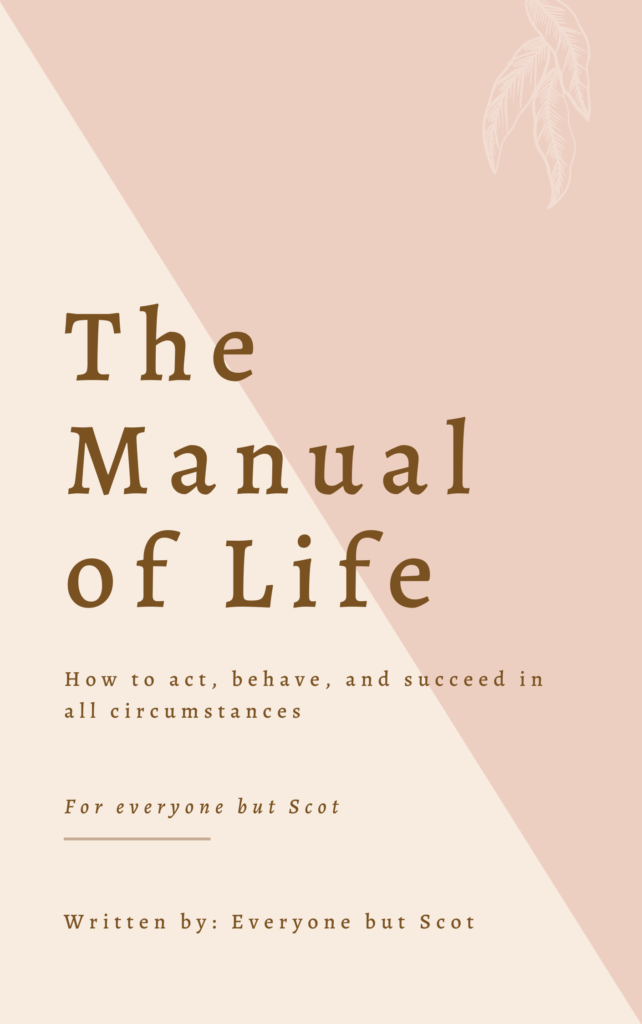
    Scot’s missing secret manual. Image made at canva.com.

    You’d think a look around my own extended family (and I don’t think we’re very different from most other families) would have assured me that wasn’t the case: plenty of failed relationships and divorces, various struggles with addictions, family members cutting each other off or not talking to each other…. Those aren’t the outcomes of people that have the secret manual. My family provided plenty of evidence that it wasn’t just me, but I didn’t really see it.

    So why didn’t I get the lesson that everyone struggles with life and it’s not just me when I had ample evidence within my own family? Well for one, although these struggles existed, we still never talked about them. We didn’t talk about the mistakes we were making or the doubts and uncertainties we had. So, although I saw the results of normal people struggling with life’s challenges, I could still safely ascribe the troubles to circumstances or one-off issues, not universal cluelessness as we all struggle with finding our path through life.

    Even my history and biography reading could have conveyed this message to me, but I didn’t hear it there either. Partially, because their purpose is usually not the struggle itself, but the resolution, thereby tending to actually increase the impostor feeling in the reader. And partially because, as with my family, I applied the inverse fundamental attribution error1 – I attributed good intentions and bad circumstances to others’ misfortunes and incompetency and failure to my own.

    My personal impostor was so strong that I saw others’ struggles and undesired outcomes, I vowed not to replicate them, and yet I continued to believe everyone else knew what to do and only I struggled to get through life and find happiness, connection, and fulfillment within it. Universal incompetence at solving life was right in front of me, but I was blind to it and believed I was the only incompetent one.

    Years ago, I started to include fiction back in my reading list, and meeting a poet at a friend’s gathering once, I began to read (and later write) some modern verse. I was listening to a lot singer songwriters (having already gone down the Blues rabbit hole years before). Who writes more songs of struggle and pain than singer/songwriter-types and Blues musicians? Every book, every verse, every lyric, every movie even – all were further evidence that to struggle, to mess up, to be lost, are all part of the human condition. And yet, still, I remained blind, and thought it was only me – that I was the only one without the secret manual.

    I’m not sure what eventually opened my eyes, but they did open and I began to share some of my doubts and struggles with others and I got back not just sympathy and empathy, but an understanding of others’ life struggles as well. We began to talk about what we never talk about and I became more open to the idea that maybe it wasn’t just me. Maybe it’s all of us. I now see this in every book I read, movie I watch, song I hear. This message is everywhere, yet, apparently, it’s also surprisingly easy to ignore.

    I now wonder if this isn’t the primary purpose of literature, stories, movies, poetry, music, theatre (has to be spelled in the British style in this context): to talk about what we don’t talk about to help people realize we are not alone, we all struggle, and no one has all the answers. It was there in front of me, in front of all of us, all this time. We just have to see it and we have to be willing to talk about it and share our doubts and struggles with each other. It is through this work that we will overcome our obstacles and connect with humanity around us in ways impossible in curated social media.

    The secret manual? I’m beginning to think this is it. We all struggle. We are all impostors. There is no secret manual. This is the secret manual. It’s not a secret. Talk about it. Share it with someone. That’s how we get through this. Together.


    1 The fundamental attribution error – our tendency to apply malice or ill intent to other people’s behaviors and environmental circumstances and good intentions to our own. The person that cuts us off on the road is a jerk and a lousy driver; when we cut someone off it’s because we were distracted and inadvertently made a mistake. It’s interesting that I’ve never thought before about how the impostor syndrome actually reverses this logic. Either way, though, the assumption generally remains an error.


  • What exactly should managers manage?

    At Facebook, moving into management is not a promotion. It’s a lateral move, a parallel track. Managers are there to support people and to remove barriers to getting things done. Managers focus on building a great team, creating a vision for how that team will execute its goals, and helping the people on that team develop in their careers. They are put in those positions because of their strong people skills. They aren’t there to tell teams what to do. This viewpoint has become so effective that some managers at our company have even gone so far as to stop saying things like “my team,” instead opting for things like “the team I support.”

    I forget exactly where I found this, but here is one source:  https://www.inc.com/jessica-stillman/3-tricks-facebook-uses-to-shut-down-toxic-office-politics.html

    I really like this idea and it supports this general notion I have that concentrating power at the top with direction flowing down is the wrong way to run an organization.  At my organization, managers used to propose projects, evaluate which we could and should do, and then worked to form teams that carried them out.  We’ve grown a bit since then in that we accept project proposals from all staff, but we still let a small group of executive managers decide which we should do.  There’s a tacit understanding that executive management has to set the strategies, and therefore the tactical plans, for the organization.

    Our next growth step, I hope, is to allow staff themselves to select which projects we execute.  Managers, then, would have the job, as at Facebook, of creating environments where people can work effectively, and where staff understand the observatory’s strategies and operating constraints well enough to make the right decisions.  As Ricardo Semler explained in his book, Maverick, this means management has to make the organization’s finances, regulations, governance and other constraints accessible to the staff. Educate them in the nature of the business so they can use their experience on the lines to develop new solutions and projects that propel the organization forward.  (Ricardo even went so far as to hold accounting classes that taught employees how to read and understand the company’s income statements and balance sheets.)

    The next step would be to consider who owns and develops the organization’s strategies.  Is it executive management or the staff? Do executives make the strategy, then educate staff so they can figure out the best way to implement it, or do executives explain to organization’s environment so that staff can both develop and implement the appropriate strategy? What is the role of the visionary leader executive if not to develop clever strategies that when efficiently executed by employees lead to industry success?

    My answer to those questions involve removing the word “executive” from my last question. Why does the visionary leader have to be an executive? Furthermore, why does the visionary leader have to be a single person?  Don’t we get more opportunities to develop clever strategies if we reach out to all our staff and give them the ability and access to chart the organization’s future? Isn’t that the role of management – to maximize the value each employee adds to the organization? If a line employee has a compelling vision, there is no reason to stifle it just because the originator is not in executive management!

    That’s the organization I’d like to see. Management that creates environments in which employees can work effectively and that educates staff on the organization’s business so that good ideas, tactical or strategic, can come from anywhere within the organization, producing staff that all have the ability and knowledge to identify and carry our their best ideas.


  • Great leaders: Are personal crucibles a prerequisite?

    I’ve been reading the book Strengths Finder 2.0, by Tom Rath.  Like one of my favorite business books, First, Break all the Rules  by Curt Coffman and Markus Buckingham, Strengths Finders 2.0 relies on data gathered from extensive Gallup surveys to help the reader discover and understand their five (out of 34 possible) top strengths.  The author’s premise is that we gain more by concentrating on our strengths than we do trying to improve our weaknesses.

    In the end, I did not find my five identified strengths terribly enlightening. The premise that we should spend more time working on maximizing our strengths – both by strengthening them and by maximizing how often we use them – and less time improving our weaknesses, however, resonated with a couple other things I have been thinking about recently:

    1. Performance evaluations: I think we spend too much time pointing out weaknesses and developing improvement action plans when we do annual employee evaluations. I would like to see people figuring out what went really well, why, and how we can set things up to realize similar successes in the future. That is, performance evaluation discussions should dominantly be about doing more of what we do best and not about trying to be a little bit better at what we do poorly.  But then I get this nagging feeling that weaknesses are important to. Weaknesses make us blind to entire pathways of opportunity. Weakness make us fail to connect to people who think drastically different than we do.  If all we did was capitalize on our strengths, we would reach a certain level of success quickly, but to transcend to the next level, I think, requires an understanding and embracing of our weaknesses.
    2. Great leaders:  All the great leaders in  Bill George’s book, True North, went through at least one particularly difficult and personally challenging life-changing event on their path to becoming great leaders.  George’s belief is that it is through life’s experiences that we discover our true north, our purpose and our reason for leading.  Author Rajeev Peshawaria takes a similar approach in another book I enjoyed, Too Many Bosses, Too Few Leaders. While reading these books, I  began to ponder: do all leaders need what George calls a “crucible” to be successful? If you do not have a life-changing event of tragic proportions, does that mean you cannot be a great leader? What exactly is the role of the crucible? Is there something else going on besides finding a passion to lead for a particular purpose?

    I did not initially see how these two topics relate, although I have now come to think of the purpose of the crucible as the opening up and revealing a part of yourself that was previously unknown. George and Peshawaria’s main point is that crucibles give leaders a deep, personal drive that motivates themselves and others.  To this, I agree.  Yet, I think there is something more.   What crucibles also do is sort of complete the package. Crucibles make potential leaders more rounded and complete in part by exposing their weaknesses and vulnerabilities.  In revealing a sense of purpose, crucibles peel back the onion and uncover hidden parts of people’s psyches.  What used to be personal blindspots become irresistible areas of development and opportunity.   They often reveal a side of us we never knew we had – perhaps even a side we considered not only a weakness, but irrelevant.

    The best leaders know not only their strengths, but also their weaknesses. They organize their primary roles to take best advantage of their strengths while partnering with others in their areas of weakness.  They know that their weaknesses represent potential blindspots that, if ignored, hamper their ability to lead.  They also know to not only work with, but to value people that are strong where they themselves, are weak.

    George’s crucibles can help bring this clear sense of being incomplete, of seeing not only the value of our strengths, but the value of our weaknesses, as well.  This awareness helps us develop those weaknesses and to find others around us to support our weaknesses while fostering a strong drive to develop and accomplish something meaningful.

    Truly understanding ourselves is key to recognizing what our true strengths are. It helps us realize in what areas of work we are likely to excel. Truly understanding ourselves is also key to understanding our weaknesses and what aspects of our work we need to pay particular attention to and allow others to help us with.  It helps us find opportunities we would otherwise be blind to.  Understanding our strengths, supporting our weaknesses: this is beginning to sound like my paragraph on performance evaluations, yet it derived from studying a group of great leaders and their struggles.

    Which  brings us back to Strengths Finder 2.0. Yes, in terms of performance output per energy spent,  maximizing our strengths is generally going to be more rewarding  than improving our weaknesses.  But that is not the whole story. It is the knowledge of our weaknesses, our real ownership of them, that allows an additional level of growth that takes us from being good leaders to potentially great leaders.  Crucibles not only directly confront us with our weaknesses, they often expose a part of ourselves that we didn’t know we had.  Sometimes this part of ourselves ends up being a weakness that perhaps is not quite as weak as we thought.  We begin to appreciate the value of our weaknesses. That is, we are forced to re-classify what we may have previously cast off as not very important or useful, as something not only useful, but valuable.  The very act of discovery both increases our own abilities in our areas of weakness and helps us to appreciate and value others whose strengths are our weaknesses.  People that we might otherwise have not valued, we begin to see as key contributors to our mission. We begin to value, rather than shun, people who think differently from us.  I believe these results are what transform George’s (and our own) generally good leaders into great leaders.

    So, do you need a crucible to be a great leader? Perhaps not, but you do need to understand who you are, why you are, what you do well, and what values those different from you bring.  A crucible is just a convenient, if sometimes painful, way to get that.


    Fifteen years ago, Scot took a personality test and was most shocked not by his resulting personality type, but at one particular type that he clearly was not.  He was amazed there really were people – both functional and successful – that were really this type. Today, he finds  exploring that part of his own personality and working with others of that type, very rewarding and a key to working his way to being at least a good leader.

  • On systems, processes, and paperwork

    Lately, I’ve come across several proposed new systems, processes, and forms —  all developed to address an assumed real, but unstated need.  In most cases, I could see a useful purpose for the new system/process/form,  but it usually wasn’t provided to me explicitly.  I didn’t know if my interpretation of what this new proposal was all about was shared by those directing it so I often feared I would be wasting my time by doing something that wasn’t what was actually wanted.

    Developing a common framework and tools for management tasks makes sense, but there must be a system behind them, else you just end up creating a bureaucracy instead of an effective, efficient system.  I see several things to address before implementing a new system, process, or form:

    1.  What is the purpose/goal? What problem are you trying to solve?
    2. Who is your audience?
    3. What are the requirements needed to fulfill your objectives within your target audience?
    4. What are the implementation costs?
    5. What are the costs of non-implementation?
    6. Given all the above, is implementation the right approach?

    There’s nothing terribly new here, but the items above make a good checklist to go through before starting a new formal process.  If you don’t address the first three points, you may end up spending a lot of time doing something which propels you no further down the road.  In addition, if you don’t evaluate the costs of what you’re proposing against the current incurred costs in light of your available resources, you risk spending too much time on something that is ultimately not going to improve your situation enough to be worth it.

    Large projects need a fairly broad framework in which to operate.  They also, typically, staff a project office sufficiently to help produce and support this framework.  While smaller projects can also benefit from this same framework, typically the cost of doing so is prohibitively high.  So, smaller projects must think carefully about what it can do, what it can’t afford not to do, and ignore the things it can afford to not do.  Going through a similar checklist as above ought to help decide into which category a proposed new system belongs.  (Actually, I’m sure this same approach works for large projects as well — we are all resource-starved these days.)


    Speaking of checklists, Scot found the book “The Checklist Manifesto” by Atul Gawande a very good read and a great strategy for helping to ensure routine tasks are done correctly every time. Packing for trips, as an example, got immensely easier once checklists got involved.

  • Superficial pleasantries vs. honest relationship building

    In my last post, I discussed some thoughts from reading Conger, Lawler, and Finegold’s Corporate Boards book. Here is something else that caught my eye in that book that has near universal applicability -not just to corporate (or observatory) boards.

    In a section of the book on how boards can/should review themselves, the authors write about why most boards don’t end up reviewing themselves in any meaningful way:

    There was a concern it might cause disharmony in the group. It was that primitive notion of what creates more effective teams. ‘Effective’ teams in this case, are where you skirt issues of difficulty, or personal differences. It’s more like ‘We want to be able to have a drink together and like each other’ as opposed to ‘If we confront ourselves on real issues, we’ll deepen the relationship.’

    There’s not much more that needs to be said after the authors’ summary.  Too often people, managers, team leaders, team members, employees, fail to raise an issue for fear of being confrontational, of being thought of as not nice.  There’s a common (mis)perception that if we confront people, if we speak up when something is wrong, then we are not being nice; we are not being good colleagues; we are poisoning the congenial atmosphere. This attitude is, of course, silly, as the above passage points out.  By not confronting the real issue, by not making these tough decisions, we may establish a superficial pleasantness, but we don’t ever dig any deeper and build real understanding that leads everyone to peak performance and a more satisfying environment.

    Confronting people does not make you tough or mean. You can confront someone in a mean, objectifying way, or you can confront people in a helpful, supportive, personal way.  We’ve all heard of stories (usually told of great managers) who fired someone only to have them return some time later and be quite successful. Were these people fired in a mean-spirited, impersonal way? Probably not. They were probably fired with sincerity, reflecting on the fact that their employment in their current role was not only not working, but was of little benefit to either party.  They were fired with honesty.   They thus created the opportunity to learn from life’s problems.  Firing, reviewing, confronting someone with malice or dishonesty at heart does not provide a foundation from which anything greater can develop.

    Same behavior, different attitude. You can “be mean” and confront someone or you can “be nice” and confront someone.  Honest confrontation meant to improve the relationship, the teamwork, and the results is not only healthy, but necessary for high performance.   Skirting around the interpersonal issues gives you two people who can go drink together, but who won’t ever build a bond and a team that will lead to greatness.


    While Scot hopes he will never be fired with either good or bad intentions, he does look forward to opportunities to develop an honest, deeper understanding with his colleagues, although seizing these moments is still not always as easy as he would like.

  • Balancing Two Boards

    Gemini has two Boards – the Gemini Board from the international partnership agreement and the AURA Board. It’s actually a bit (well, OK a lot) more complicated than this. The National Science Foundation (NSF) is Gemini’s Executive Agency. They collect and distribute the funds for Gemini from the Gemini partnership. They also provide the funds for the US part of Gemini. AURA is our Managing Organization and is basically responsible for the management of Gemini. They have their own board and a specific oversight committee for Gemini, the AOC-G. The Gemini Board is basically our governing body, being the representatives of the partner countries to Gemini’s operating board. If each of these agencies, boards, and committees wants a review twice a year, Gemini would (and quite nearly does) end up with a major review a month. This would be bad enough, but as you can imagine, with so many organizations, boards and oversight committees, it can get a little confusing figuring out who is responsible for what and to whom. The lines of control and authority are blurred and complicated. The Gemini Board sets Gemini’s direction, yet Gemini’s Director takes home a salary provided through AURA. The reviews from the different groups in the observatory’s governance structure often end up commenting on the same aspects of the observatory while leaving other aspects untouched. In some areas, everyone wants their piece of the action, to have their say, while other aspects escape without much scrutiny at all. Overall, it’s a recipe for confusion and disorder.

    The Gemini Partnership Agreement specifies the general roles of the Gemini Board, the Executive Agency, and the Management Organization. but of course not those of each of their boards and oversight/review committees. So, even if everyone read and understood the Partnership Agreement, there would still likely be confusion. The Partnership Agreement and Management Organization’s contract will be up for renewal soon (~2015) so we have an opportunity in a few years to simplify this whole structure and come up with an organization that has clearer and cleaner lines of authority and responsibility. In the meantime, though, we still have to make things work a little better than they do now. The unclear lines of communication and authority are hindering us from becoming a true high performance organization with a single team able to focus on a common mission.

    Balancing Gemini's Boards takes some care and thought, but should not be too difficult if can agree on a clear division of roles and responsibilities.

    In their book, Corporate Boards: New Strategies for Adding Value at the Top, authors Conger, Lawler, and Finegold define the primary roles of the corporate board as follows:

    1) giving strategic direction and advice
    2) overseeing strategy implementation and performance
    3) developing and evaluating the CEO
    4) developing human capital
    5) monitoring the legal and ethical performance of the corporation
    6) preventing and managing crises
    7) procuring resources

    With only a little study, these 7 roles divide up fairly nicely to those potentially of the Gemini Board and those of the Managing Organization. The Gemini Board represents the partnership’s interest in Gemini. AURA and its boards/committees represent Gemini’s management and staff. A natural division, therefore of these roles would assign #s 1, 2, 6, and 7 to the Board and #s 3,4, and 5 to AURA. This division of roles lets the Gemini Board concentrate on strategy and resource procurement (partners, development funding, etc.) while AURA concentrates on human resources and legal operational issues. Allowing AURA the time and focus to concentrate on developing, evaluating and supporting Gemini’s human resources would be a nice benefit to this approach and would help Gemini develop and keep its best home-grown talent for future roles within the Observatory.

    This division of roles also allows the opportunity for the Gemini Board to review AURA’s performance and, if we’re really being open to new ideas, to have the AURA Board, or even better, an NSF (our Executive Agency) review committee, evaluate the Gemini Board’s effectiveness. Each Board reviews Gemini in the areas of its domain, and each Board (and/or the NSF) reviews the other Board to keep everyone honest and help ensure everyone is working as optimally as possible, together, to push the Observatory forward. This sort of separation of powers is very consistent with the responsibilities of the Gemini Board, Executive Agency, and Managing Organization detailed in the partnership agreement. The Board is given the fiscal and strategic responsibilities for the Observatory as well as oversight/review of the Managing Organization. The Managing Organization is given the responsibility to develop management plans, employ key Gemini staff, and carry out Board decisions. They are thus also the likely choice for the roles of top personnel development and review within the Observatory. The roles I’ve defined could easily be agreed upon now with only a slight extrapolation necessary from the partnership agreement, and formalized, after some time to see how it works, in the next partnership agreement.


    These are interesting times for Gemini, perhaps even more so than on average. Scot hopes discussions like this one happen often and broadly while we discuss and form the structure and organization of Gemini into the next decade.

  • Another advocate for Openness, Transparency, and Accountable Management

    Somewhat recently, I finished reading Employees First, Customers Second by Vineet Nayar.  It was a very easy read since the techniques the author talks about using to restore his company to an industry leader agree a lot with what I already believe.  Nayar makes a strong case, based on real experimentation and use, for complete transparency, honest confrontations with the truth of what problems and potential problems lay ahead, freedom of information, and making management accountable to employees and not just the other way around.

    Early on in his tenure as CEO, Nayar realized his company had slowly gotten used to being at the top, satisfied with slow, steady improvement rather than large leaps of innovation.  Nayar writes: [My company] had lost its competitive edge because it had become tolerant of gradual change … and unless the company becomes obsessed with constant change for the better, gradual changes for the worse usually goes un-noticed. He also realized the solution to the company’s problems, even awareness of the problems themselves, laid within the employees, not necessarily with the managers at the top of the traditional hierarchical structure.

    In his introductory meetings with employees, Nayar realized there were three broad-types of employees: the transformers who understood and wanted to make things happen, although they were often hampered in doing so by the corporate structure, the fence-sitters who would usually not commit to taking action until there was a clear tide pushing behind them, and the nay-sayers who would pretty much be against anything new.   The key, therefore, to getting employees to take action, was to let the transformers loose. Once they were actively working, the fence-sitters would see that the tide had changed and join in. The nay-sayers, of course, would still be nay-sayers, but you deal with those people separately, anyhow and try to get them into better situations.

    How to get your employess off the fence? Give them a honest cause to believe in and, perhaps more importantly, engage those who are ready to act now, first.

    With these sort of tenets in mind, Nayar set out to create an environment where the employees, particularly, the transformers,  could catch, promote, and solve problems themselves. He turned management upside down and instead of making employees accountable to management, made management accountable to employees.   Managers were there to respond to the line workers needs, not the other way around.  Their shared job was to create an environment where people could easily innovate and solve their company’s problems. Of management, Nayar writes: People saw that some of the managers were little more than aggregators and brokers of information.  These mangers’ entire authority lay in their control of the information.  As soon as everyone had access to it, their power might come into question. And that was exactly what Nayar wanted.  He recast the value of his managers not by their zones of hierarchical control, but by their span of positive influence.  To help evaluate the latter, Nayar opened up the employee review process to allow any employee to comment on any manager in the company, within their functional or project unit or not.Other traditional performance review processes were changed as well. For example, instead of just rewarding support services by their time to close each submitted issue/request, Nayar’s company also added an incentive to be proactive by making the total number of requests and issues received a monitored metric as well.  Someone closing 1000 issues in 10 minutes each may actually be doing a worse job than someone who only closed 100 within an average of 4 hours.   It’s easy to solve long-recurring issues quickly. It’s much more useful to eliminate those common problems and leave time available to concentrate on the larger ones instead.

    Nayar created a culture of trust in his company by whole-heartedly adopting a strategy of transparency and openness. Of one purpose of transparency, Nayar tells a short story: “Why do you have such large windows?” I asked my friend [who had very large windows fronting a busy street where all could see in]…. “It keeps the house clean,” he said. Transparency promotes accountability by all – both management and line worker;  helps make problems, issues, and solutions, known to all; and not only keeps the house clean, but provides direct, verifiable evidence that it is so.  Powerful results for a simple philosophy that is actually easier to enact than the traditional one of hiding information behind a “need to know” umbrella.

    Nayar had public talks with staff members, did live video simulcasting of other important meetings, and always focused on the truth of where the company was at any given moment (for better or worse) as well as where it wanted to go.  He called one aspect of this approach Mirror, Mirror which he described as … a communication exercise that involved talking with employees throughout the organization about the truth as they see it and getting them to acknowledge the reality, the elephant in the room, that everyone essentially knows about but which has never been publicly acknowledged. This exercise sounds a lot like the looking underneath the rocks aspect of Good to Great. Not only do these exercises get the employees to see and acknowledge company issues, but it often gets them known to management for the first time!

    After getting the employee insights into the company’s problems and issues, Nayar engaged them in the solution process, as well.  He writes: Mahatma Gandhi, Nelson Mandela, and Martin Luther King Jr. … these great leaders did not formulate strategy by retreating with their top people to a private place and then emerging to make a pronouncement to the masses. No, they walked the roads of their countries, met their people, and talked with them ceaselessly, – just like the Level 5 leader of Good to Great.

    There’s a lot more to Nayar’s story than what I summarized here and I think it is also important to note that not everything Nayar tried went well.  Some solutions brought unintended consequences that either had to then be corrected, or a new solution put in place instead.  Other solutions, though, brought along unintended additional solutions, as well.  I think a key to Nayar’s success, as well as to that of the Level 5 leaders of Good to Great, is an inclusive, honest dialog, an erring towards too much available information rather than too little, and a willingness to try and experiment with new ideas.  No solution is going to solve everything, but if each one gets you further down the path to continual improvement, you’re doing very well indeed.


    Scot’s best teams, both to manage and work within, were hierarchically fairly flat. Equal access to information and abilities to propose and implement solutions makes it exciting to be part of a team and working on a problem. You can create an atmosphere where people moan in the hall ways about what is wrong with the company or you can create one where people buzz in the hall way about what each of them are doing to overcome the current problems.

  • Healthy Conflcit

    I recently picked up a copy of A Grand and Bold Thing by Ann Finkbeiner. It’s a book about the original Sloan Digital Sky Survey (SDSS). I actually haven’t read it yet, so I’ll probably say more about the book later, but I have had some fun flipping through the pages and reading/re-living various random passages and episodes. One thing I noticed by this quick perusal is that Finkbeiner seems to have chosen to focus her book on Jim Gunn (of course) and the Princeton / FermiLab tension that defined the project for a large part of its life. Upon reflecting on this choice, I realized there was no shortage of conflict within the SDSS and not limited to these two powerhouses. Yet, when I remember the years I spent with the SDSS, conflict is not one of the first things I think about.

    No, instead I think about people’s drive and dedication to the project. I think about a group of people faced with a limited amount of time and money doing whatever it took to get their shared project done. I think about a talented group of people making each other better. And yes, I think of conflict, but a conflict born out of this shared mission, a drive to succeed, and ultimately, enough trust in each other that discordant views could be aired and the right answer would get chosen, regardless of its origin. I even remember instances where conflict was created as a mehanism to help spur progress.

    So yes, there was conflict, Plenty of it.  Did people get bent out of shape, angry, annoyed? Did some people cross the line and make personal attacks? Did things sometimes get out of hand? Yes, yes, yes. And certainly some of this conflict could have, should have even, been avoided, but my point here is that for this project, conflict worked very well. The Sloan Digital Sky Survey was (and still is) an unmitigated success.

    That conflict was so alive and flourishing I take as a sign of a healthy organization where trust and security were high enough to allow open conflict.

    I certainly don’t generally condone creating conflict to try and improve productivity (although it can have its instances). What I do condone, though, is creating an atmosphere where conflict can and does naturally arise. Only when people are being honest with each other, have passion about what they are doing, and are generally united with a common ultimate goal in mind, does healthy conflict arise. Before you try creating conflict, try creating an atmosphere of trust and security. Seek out and listen to dissenting views. Fix the system, not the person, when mistakes are made. Establish a culture of openness and trust. Help people feel secure enough in their positions to know that mistakes are not personal failings and that false harmony is not the key to a productive workforce.  These things will create an atmosphere where honest conflict can arise, pushing, pushing, pushing at the boundaries of your project to do things better, faster, cheaper.  If you don’t have open conflict, you probably don’t have a very high performing organization.

    Another thing I think about when I think about the SDSS is the difference between projects and institutions. Projects have a limited set or resources and time to complete a task. They therefore have to be focused and directed or else their project will fail. Institutions don’t have these same constraints.With a more or less guaranteed stream of funds, they merely have to do better this year than last year. Things can wait for an institution where they can’t in a project. What’s even more interesting here, though, is that there is nothing preventing institutions from acting like projects, despite their more steady funding. I think adopting many of a project’s methods and mentalities will help propel an institution to continued excellence and to not be content with simple steady improvement.


    Scot remembers one of his first days with the SDSS. Standing around the breakfast table, he commented how exciting it was to be involved in the project at the such an early stage (official survey operations having not yet started). A visiting, real longterm Sloanie simply laughed and said that this was actually closer to the end of the project than it was the beginning. A very valuable perspective was thus quickly gained.