
Tag: Scientist Dilemma

  • The Management Corollary

    OK- I have several other things I’d like to discuss: some thoughts from my current reading material, First, Break all the Rules and some thoughts on the UK’s announcement that it will probably withdrawal from Gemini and what it means to the Observatory, for example, but I thought I should close out my bit on the Scientist Dilemma and the Management Corollary from my 2008 SPIE paper first. Here, then, is how I introduced the Management Corollary in that work:

    Scientists are not usually trained as mangers and managers are not usually trained as scientists. There are some talented people who can play both roles, but rather than relying on the exception, it is safer to plan for the more commonplace scenario.

    Like software engineers, professional managers exist for a reason. They are trained in evaluating personnel, logistics, scheduling, fund-raising, etc. — all things not usually found on the transcript of your average scientist. On the other hand, they are not always well-versed on the science of their missions and less able to make well-informed compromises between a project’s logistical and scientific needs. The Large Synoptic Survey Telescope project is addressing this problem by putting both a trained scientist and an experienced manager in each management box of their organizational chart. This approach seems sound and time will tell how well this works, but the important point is to recognize that science leadership and management leadership are two different things and it is rare to find someone sufficiently effective in both.

    One of the first images of an extra-solar planetary system from Gemini Observatory.  A result like this requires great efforts by individual scientists and project management to make happen.
    One of the first images of an extra-solar planetary system from Gemini Observatory. A result like this requires great efforts by individual scientists and project management to make happen.

    Now I am going to venture off into even more generalizations – a habit which often gets me in trouble – but I think the generality addresses a point that we need to address. Compounding the problems described above even further is that scientists and engineers are often actually resistant to even the idea of management. For one, our lengthened education and noble “search for the truth” sometimes makes us feel that our efforts are above the need for management. Second, most of us went into science and related technical fields to actually do things; not manage things. If we wanted to manage things, we’d be wearing our pressed-shirts and jackets, working 9-5 and making more money (I know that’s not fair to the “real-world” managers out there, but hopefully you see my point). Our rewards and training have both been for doing things, not managing others to do things. Those who don’t do are often looked on as necessary, at best (and usually not even that), and certainly with a little disdain as well. Let’s face it, as a group, we don’t respect management. We feel our motives and aspirations do not require management and we want do to things – in line with our own vision of how to reach the truth – not manage things, or worse, be managed to do things.

    So where does that put us? We are not trained as managers, we don’t like to manage, we don’t like to be managed, and we don’t really even respect the field of management, yet we work on projects costing untold amounts up to hundreds of millions of dollars and involving communities of thousands of users across multiple countries and cultures. I’d say there’s a lot to be done to improve the role, visibility and contributions of effective management to astronomical projects at all points in a person’s career – from school education through project initiation, completion, and operation. Granted, there are many good managers in astronomy and most large projects appreciate and exert good management, but management in astronomy still has a deeply seated reputation problem and we have still have many managers who continue to try to do rather than facilitate others to do. So here again is part of the reason for this blog – to talk about the role of management in astronomy and to discuss how to best find and employ the experiences and talents necessary to complete large astronomical projects as efficiently, accurately, and completely as possible.


    Like most managers in astronomy, Scot didn’t start out thinking he’d end up managing astronomical projects (pun intended), but has found it a nonetheless interesting career path. He still tries to do, from time to time, and is currently working on a new catalog of White Dwarf stars which will about multiply the number of known white dwarf stars by a factor of two from the last catalog and a factor of 7 from 5 years ago. Although this desire to still occasionally do may make him part of the problem described above, he thinks some commitment to doing is healthy and can directly contribute to a astromanger’s management success, an idea for another post, most likely.

  • Astronomy is a Business

    I had intended to follow-up my last post on the Scientist Dilemma with one on what I call the Management Corollary. However, events this week have me thinking on a slightly different, but related tack that I think will be worth exploring first. It will help pave the way for a more in-depth look at the challenges of astronomy management later.

    Astronomy is a business. Well, maybe not all aspects of it, but these days, astronomical facilities like observatories are a business. There are now multiple options in all size ranges – from 1m to 30m diameter telescopes. Institutions and countries with money to invest in facilities have multiple selections from which to choose. How then, do they choose where to invest? They look for the facility that offers the best product for the least money. That sounds like a business to me.

    This situation is a relatively new state of affairs. There are more 8-10m class telescopes than there are 4m telescopes. (Well, it depends a little how you count then, but the numbers are at least comparable.) For the next generation of telescopes, we have at least the TMT, GMT, and E-ELT to choose from. If you’re a government looking to provide the latest resources to your astronomers, you have choices. And once again, you would obviously choose by attempting to maximize the value you get for your money.

    This state of affairs means observatories must work to provide a better product for a lower cost if they hope to continue and grow with time. Many scientists and engineer types don’t want to think this way. They don’t want to be bound by business-world processes and instead prefer to think of themselves as above the fray – engaging in pure research for the sole sake of expanding human knowledge. This goal is indeed noble, but you can’t do research without money, and sitting through the Gemini Board meeting last week, it crystallized that you don’t get money if you don’t offer value your competitors don’t.

    2009 is the International Year of Astronomy - another example of astronomy as a business, promoting itself to the general public.
    2009 is the International Year of Astronomy – another example of astronomy as a business, promoting itself to the general public.

    Ours is certainly a business that includes a research function, but like all high-tech businesses, the research aspect is but a part of the business and its focus better be aligned with the business’s mission and market needs. An astronomy facility that doesn’t innovate and keep pace with technology will not survive. Technological research is a vital part of its mission, but it is not the mission itself.

    This state brings up the Scientist Dilemma from a different angle: our facilities need active research and technical development to stay competitive, but they also need to do so at as low a cost as possible. Thus, an observatory wants scientists to innovate for the observatory, not for themselves. The observatory wants scientists to continue to expand and improve the facility’s capabilities, but wants to do so efficiently. Publishing papers internally, for example, does little to increase an observatory’s market value. But if an observatory doesn’t support their scientists publishing papers, a) they won’t be able to attract scientists in the first place, and b) they will lose innovation that benefits the observatory’s market value by having researchers push the capabilities to the limit as they develop new techniques and tools for their research. In other words, it is a careful balancing act that must be done to stay competitive. The choices that are made to balance cost efficiency and internal research and development are critical to an observatory’s future success.

    Finally, as a slightly different take on what I think is actually the same topic, I offer a link to Jim Gunn’s famous diatribe on the HST mirror disaster. I believe one thing Jim is saying here is that as astronomers, we need to take responsibility for both the research and the business side of our projects, lest we become vulnerable to our fate being controlled by people who do not understand the full picture. I’m not sure I agree with his view on national facilities, but perhaps that’s a topic for another post some day.


    Scot has actually never found the concept of astronomy as a business difficult to accept. Its product is science and knowledge, instead of something you can buy on late-night TV, but the parallels between commercial businesses and astronomical facilities are easy to identify. He enjoys reading management books, as well as astronomical treatises. Current in-progress books include “First, Break all the Rules” and “Dark Cosmos: In Search of Our Universe’s Missing Mass and Energy”.

  • The Scientist Dilemma

    I wrote the following for an SPIE paper I presented on lessons learned from the Sloan Digital Sky Survey, but I still think there is material to discuss here. I also plan to expand upon these thoughts in my next post and talk about the Scientist Dilemma as it pertains to management.


    Astronomy projects often need very specifically-skilled people to play largely support roles. Scientists are not always needed in all skilled positions, but when they are, they present an additional complication: they usually want to do science. Rewards and professional development need to be included in their work plan. The conflicting needs of the project (support) and the desires of the scientists (science) form what may be referred to as the scientist dilemma. The scientist dilemma occurs whenever highly-skilled, scientifically motivated people are needed for support work. This work could be, as in the case discussed here, operations and observations, but the dilemma applies equally well to programmers, data analysts, archivists, etc.

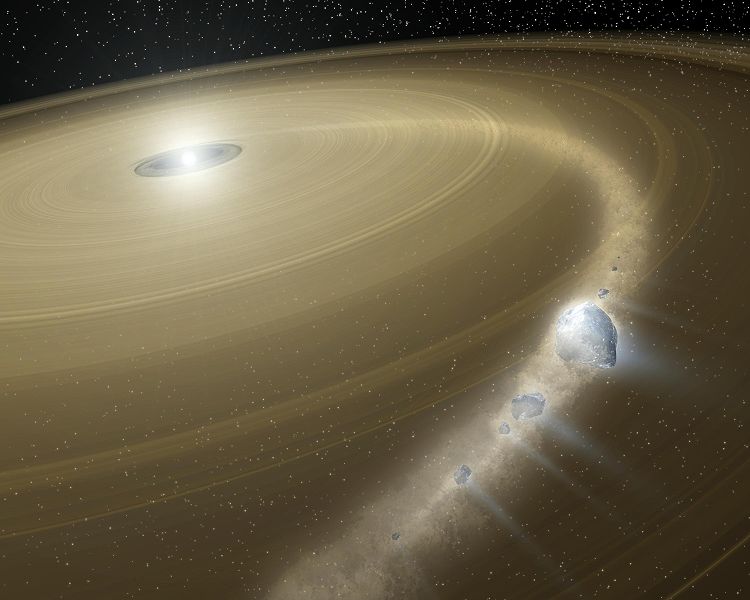
    An artist's perception of the debris disk surrounding the white dwarf star, G29-38. (NASA)
    An artist’s perception of the debris disk surrounding the white dwarf star, G29-38. (NASA)

    The SDSS collaboration realized early on that Ph.D.-level people were going to be required for nightly operations. It wasn’t so much the degree itself that was necessary, but several factors that come with it: observing experience, data handling and analysis, scientific context, problem solving, and an exposure to scientific computing environments. It is certainly possible to find these skills and experiences in someone without a Ph.D., but they are more common in those with it. The telescope, instrument, software, and data systems were complex enough that a high level of skill was demanded to successfully use and develop them. In addition, the nightly observing plan was flexible enough to the current conditions that scientific tradeoffs between different courses of action would need to be evaluated in real time to optimize each night’s observations. We also realized that a stable group of skilled observers could not only hone the operating systems and procedures to improve both efficiency and data uniformity, but could also take over some of the software and hardware development work as well, more finely tuning the initial efforts to fit real observing conditions. This work resulted in continual operational efficiency improvements and left the system in such a state that by the end of the project, Ph.D.-level scientists were no longer required to make operations successful.

    The problem with this approach is that whereas the project wanted Ph.D.-level astronomers to learn and understand the complex operational systems, spend non-observing time improving the systems and performing required auxiliary tasks (instrument calibration, data integrity checks, etc.), decide coherent efficient nightly observing strategies, and operate the telescopes and instruments nightly during observations, most Ph.D-level astronomers want to do (at least some) astronomy — hence the dilemma.

    The only way to really address this dilemma is to simply staff accordingly, allowing your professional staff enough time to do their three main tasks: in this case, observing, system verification and development, and scientific research. Without the latter, not only do you not have happy workers willing to devote themselves to the project for its duration and give you the benefits of their scientific activities, but you also leave them with no career path beyond future, non-scientific support work.


    I went on to discuss other aspects of this issue, its solution and how to keep people through the end of a project, but I think these few paragraphs get the main point across and will provide the background for my expansion of this dilemma into scientific management.


    Scot did his Ph.D. thesis largely on G29-38, a very interesting pulsating white dwarf star with an infrared excess caused by a circumstellar debris disk as pictured above. His thesis, however, had nothing to do with debris disks and instead used G29-38 as a prototype to understanding the pulsational, and hence, compositional, properties of this subclass of white dwarf pulsators. These days, he is using SDSS data to produce new catalog of white dwarf stars to better understand their global and peculiar properties.