Tag: SDSS

  • Healthy Conflcit

    I recently picked up a copy of A Grand and Bold Thing by Ann Finkbeiner. It’s a book about the original Sloan Digital Sky Survey (SDSS). I actually haven’t read it yet, so I’ll probably say more about the book later, but I have had some fun flipping through the pages and reading/re-living various random passages and episodes. One thing I noticed by this quick perusal is that Finkbeiner seems to have chosen to focus her book on Jim Gunn (of course) and the Princeton / FermiLab tension that defined the project for a large part of its life. Upon reflecting on this choice, I realized there was no shortage of conflict within the SDSS and not limited to these two powerhouses. Yet, when I remember the years I spent with the SDSS, conflict is not one of the first things I think about.

    No, instead I think about people’s drive and dedication to the project. I think about a group of people faced with a limited amount of time and money doing whatever it took to get their shared project done. I think about a talented group of people making each other better. And yes, I think of conflict, but a conflict born out of this shared mission, a drive to succeed, and ultimately, enough trust in each other that discordant views could be aired and the right answer would get chosen, regardless of its origin. I even remember instances where conflict was created as a mehanism to help spur progress.

    So yes, there was conflict, Plenty of it.  Did people get bent out of shape, angry, annoyed? Did some people cross the line and make personal attacks? Did things sometimes get out of hand? Yes, yes, yes. And certainly some of this conflict could have, should have even, been avoided, but my point here is that for this project, conflict worked very well. The Sloan Digital Sky Survey was (and still is) an unmitigated success.

    That conflict was so alive and flourishing I take as a sign of a healthy organization where trust and security were high enough to allow open conflict.

    I certainly don’t generally condone creating conflict to try and improve productivity (although it can have its instances). What I do condone, though, is creating an atmosphere where conflict can and does naturally arise. Only when people are being honest with each other, have passion about what they are doing, and are generally united with a common ultimate goal in mind, does healthy conflict arise. Before you try creating conflict, try creating an atmosphere of trust and security. Seek out and listen to dissenting views. Fix the system, not the person, when mistakes are made. Establish a culture of openness and trust. Help people feel secure enough in their positions to know that mistakes are not personal failings and that false harmony is not the key to a productive workforce.  These things will create an atmosphere where honest conflict can arise, pushing, pushing, pushing at the boundaries of your project to do things better, faster, cheaper.  If you don’t have open conflict, you probably don’t have a very high performing organization.

    Another thing I think about when I think about the SDSS is the difference between projects and institutions. Projects have a limited set or resources and time to complete a task. They therefore have to be focused and directed or else their project will fail. Institutions don’t have these same constraints.With a more or less guaranteed stream of funds, they merely have to do better this year than last year. Things can wait for an institution where they can’t in a project. What’s even more interesting here, though, is that there is nothing preventing institutions from acting like projects, despite their more steady funding. I think adopting many of a project’s methods and mentalities will help propel an institution to continued excellence and to not be content with simple steady improvement.


    Scot remembers one of his first days with the SDSS. Standing around the breakfast table, he commented how exciting it was to be involved in the project at the such an early stage (official survey operations having not yet started). A visiting, real longterm Sloanie simply laughed and said that this was actually closer to the end of the project than it was the beginning. A very valuable perspective was thus quickly gained.

  • The never-ending battle between big and small science in astronomy

    When you hear the thundering herd behind you, it’s time to move on to a new field. That’s advice I often heard from my graduate advisers. While you might call this a “small science” mindset, they went on to found the Whole Earth Telescope (WET), an international collaboration of astronomers at more than a dozen observatories around the world that coordinated observations to follow variable (white dwarf) stars continuously for up to two weeks at a time, clearly a “big science” approach. The WET was initially very successful, and began to falter only later as it struggled to transition from a bunch of astronomers doing what they needed to do to get their science addressed, to an institution looking to continually justify its funding and purpose.

    I recently finished Giant Telescopes by Patrick McCray, a book basically about the origins of the Gemini Observatory. I was struck at how many of the same arguments that were in the community decades before Gemini, persisted up to and through its construction and are still being debated today. Principally, the question of private vs. public and big science vs. little science. In my earlier posting about The role and need for an international observatory, I gave some of my thoughts on the first question so here, I want to at least introduce the latter.

    A few years back, Simon White and Rocky Kolb submitted a set of papers, each championing for the big science or little science models for astronomy. There was even a pseudo-debate between them at the 2008 AAS meeting (http://aas.org/taxonomy/term/27 – session 87 – where you can see a video of the discussion). Simon White’s paper was Fundamentalist physics: why Dark Energy is bad for Astronomy while Rocky Kolb’s, issued in response, was entitled A Thousand Invisible Cords Binding Astronomy and High-Energy Physics. The context for this particular discussion was Dark Energy, but the underlying issue was really whether or not astronomy should be done in a big science or little science approach.

    An artistic interpretation of the crystallized white dwarf star, BPM 37093, observed by the WET.BPM 37093 is so massive, that theory predicts its core, mostly carbon and oxygen, is crystallized. Here on Earth, crystallized carbon is called diamond. Observations of the oscillations of this star with the Whole Earth Telescope were consistent with this interpretation and placed strong limits on the amount of crystallization within the star, a diamond in the sky.

    I don’t think this argument will ever really die since we will always have competing projects that are each done best under a different model. The solution is going to be to continue to adapt and be aware of the compromises and needs necessary to keep both approaches viable. One interesting moment in the 2008 AAS “debate” was when an audience member asked what each would like to adopt from the other side. Simon White said of high energy physics “managing large projects” while Rocky Kolb said of astronomy “making data public”. What I liked about this question and its responses was that it acknowledged that we don’t have to simply emulate the high energy physics big science model, nor steadfastly stick to astronomy’s traditional small science mode, but we can learn from both and make something better than either alone. The Sloan Digital Sky Survey (SDSS), like the WET, is a good example of this kind of approach. A core group of people inspired and really implemented the survey, with formal management and technical support partially adopted from the particle physics world. The SDSS used both public and private funding and made all the data publicly available after a short proprietary period. This melding of approaches helped make the SDSS one of the most successful projects of its type and certainly helped pave the way for even larger projects like the LSST and PanSTARRS.

    So the question isn’t big science vs. small science in astronomy, but how do we create an environment where both can exist, cooperate, and thrive? With 30m telescopes, 8m surveys, and pushes to build large, wide-field survey imagers and spectrographs, astronomy must learn to embrace big science, although we can do so on our own terms, not necessarily on those laid before us by other fields and previous projects. This debate is similar to the one on public vs. private facilities. A true strength of the astronomy community is that both public and private facilities have been successful. That both are continuing to debate why they each need more resources than the other means the community is relatively healthy. The next hurdle in both these arenas will be how to ensure the appropriate levels of cooperation between each community. How do you motivate private funding when the data become public to all? How do you (or do you?) justify public funding when the resulting data remain private? How do you make sure individual contributions are visible and not an anonymous contribution to a juggernaut project? How do you handle risk in a extremely delicate, risk-adverse, funding environment, especially in a field which traditionally pushes at the outer limits of available technology, a fundamentally risky task?

    I’ll try to address some possible answers to these questions in future posts.


    Starting off with the Whole Earth Telescope, then onto the SDSS, Subaru, and now Gemini, Scot has been involved in increasingly “larger” science, but has always managed to come away with his own “small” science projects within each. He particularly enjoyed doubling the number of known white dwarf stars from SDSS data of largely failed attempts to find Quasars!

  • The Scientist Dilemma

    I wrote the following for an SPIE paper I presented on lessons learned from the Sloan Digital Sky Survey, but I still think there is material to discuss here. I also plan to expand upon these thoughts in my next post and talk about the Scientist Dilemma as it pertains to management.


    Astronomy projects often need very specifically-skilled people to play largely support roles. Scientists are not always needed in all skilled positions, but when they are, they present an additional complication: they usually want to do science. Rewards and professional development need to be included in their work plan. The conflicting needs of the project (support) and the desires of the scientists (science) form what may be referred to as the scientist dilemma. The scientist dilemma occurs whenever highly-skilled, scientifically motivated people are needed for support work. This work could be, as in the case discussed here, operations and observations, but the dilemma applies equally well to programmers, data analysts, archivists, etc.

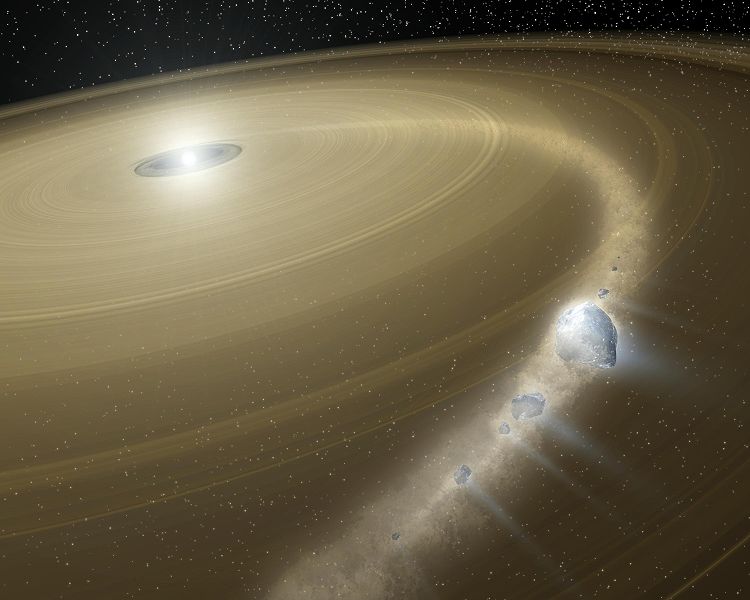
    An artist's perception of the debris disk surrounding the white dwarf star, G29-38. (NASA)
    An artist’s perception of the debris disk surrounding the white dwarf star, G29-38. (NASA)

    The SDSS collaboration realized early on that Ph.D.-level people were going to be required for nightly operations. It wasn’t so much the degree itself that was necessary, but several factors that come with it: observing experience, data handling and analysis, scientific context, problem solving, and an exposure to scientific computing environments. It is certainly possible to find these skills and experiences in someone without a Ph.D., but they are more common in those with it. The telescope, instrument, software, and data systems were complex enough that a high level of skill was demanded to successfully use and develop them. In addition, the nightly observing plan was flexible enough to the current conditions that scientific tradeoffs between different courses of action would need to be evaluated in real time to optimize each night’s observations. We also realized that a stable group of skilled observers could not only hone the operating systems and procedures to improve both efficiency and data uniformity, but could also take over some of the software and hardware development work as well, more finely tuning the initial efforts to fit real observing conditions. This work resulted in continual operational efficiency improvements and left the system in such a state that by the end of the project, Ph.D.-level scientists were no longer required to make operations successful.

    The problem with this approach is that whereas the project wanted Ph.D.-level astronomers to learn and understand the complex operational systems, spend non-observing time improving the systems and performing required auxiliary tasks (instrument calibration, data integrity checks, etc.), decide coherent efficient nightly observing strategies, and operate the telescopes and instruments nightly during observations, most Ph.D-level astronomers want to do (at least some) astronomy — hence the dilemma.

    The only way to really address this dilemma is to simply staff accordingly, allowing your professional staff enough time to do their three main tasks: in this case, observing, system verification and development, and scientific research. Without the latter, not only do you not have happy workers willing to devote themselves to the project for its duration and give you the benefits of their scientific activities, but you also leave them with no career path beyond future, non-scientific support work.


    I went on to discuss other aspects of this issue, its solution and how to keep people through the end of a project, but I think these few paragraphs get the main point across and will provide the background for my expansion of this dilemma into scientific management.


    Scot did his Ph.D. thesis largely on G29-38, a very interesting pulsating white dwarf star with an infrared excess caused by a circumstellar debris disk as pictured above. His thesis, however, had nothing to do with debris disks and instead used G29-38 as a prototype to understanding the pulsational, and hence, compositional, properties of this subclass of white dwarf pulsators. These days, he is using SDSS data to produce new catalog of white dwarf stars to better understand their global and peculiar properties.