Tag: Communications

  • In search of life’s secret manual

    Want to find that secret manual that tells you how to behave in all situations, overcome life’s challenges, reach your potential, and connect with those around you? I spent years looking for such a manual, one that I was convinced everyone else had access to, but I didn’t. My answer now: read a book! Well, a novel, really. Or some poetry. A biography, if you must, but preferably not. Find a fiction best seller list and start reading. Why? Well first let me give you some background.

    Some years ago, probably around the time I started reading management books, but likely even before that, when I read technical books, history, or scientist biographies, I not only stopped reading novels, but I sort of proudly declared myself devoid of time to read fiction. Who could be bothered with fiction when there’s so much to learn from non-fiction? Well, me, for one. Or, at least I should have been.

    Another useful bit of useful background is the impostor syndrome. I could do a whole post about the impostor syndrome (and frankly, I’m kind of surprised I haven’t by now), but I think it’s a concept that is becoming pretty well known these days, so let me just summarize it as that common feeling we get that we are not really qualified to do what we are doing and that some day, someone will discover that we’ve just been faking it and the gig will be up. The origin of the impostor syndrome is easy to understand: we all know our own self doubts or struggles and yet, we don’t talk about them and more specifically, those we work and interact with don’t talk to us about their doubts and struggles – they only tell us all the great things they can do. Modern, curated social media tends to make that sense even worse. We end up with the misguided impression that everyone else knows what they’re doing and we know we don’t, so we feel like an impostor.

    One of the ways out of the syndrome is recognizing that everyone has feelings like this and everyone has their own doubts that they just don’t talk about. If you are an impostor, so is everyone else around you, so who cares any more?

    I admit I still find myself feeling like a professional impostor at times, but then I remember what I just said above and I remind myself that while there is always someone who knows more about a specific topic than I do, or more about more different things than I do, I also know more than others. I tend to go deeper than most people who are as broad and broader than most people who are as deep. That’s my trick and it’s been my strength and niche and it sort of keeps the professional impostor at bay.

    But what I only recently realized is that while the professional impostor was reasonably dealt with, the personal one has been front and center in my life for a long time, without me even being aware of it. I truly believed that everyone else in nearly every life context had the secret manual that I somehow never got a hold of. They all knew how to act, behave, and overcome life’s obstacles in ways that I simply didn’t. Why was I so messed up and struggling in things everyone else just got?
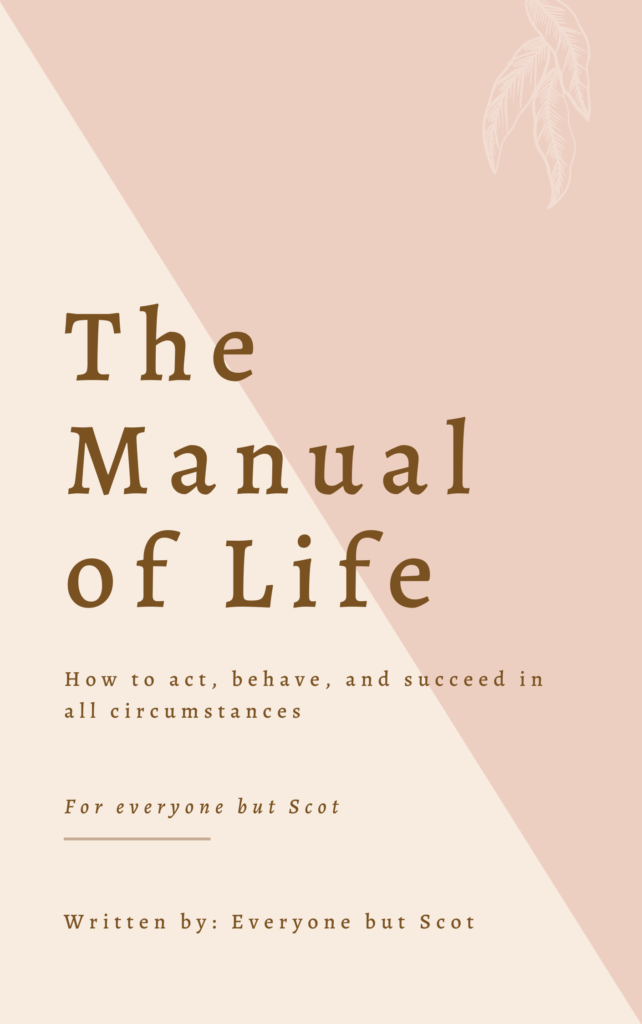
    Scot’s missing secret manual. Image made at canva.com.

    You’d think a look around my own extended family (and I don’t think we’re very different from most other families) would have assured me that wasn’t the case: plenty of failed relationships and divorces, various struggles with addictions, family members cutting each other off or not talking to each other…. Those aren’t the outcomes of people that have the secret manual. My family provided plenty of evidence that it wasn’t just me, but I didn’t really see it.

    So why didn’t I get the lesson that everyone struggles with life and it’s not just me when I had ample evidence within my own family? Well for one, although these struggles existed, we still never talked about them. We didn’t talk about the mistakes we were making or the doubts and uncertainties we had. So, although I saw the results of normal people struggling with life’s challenges, I could still safely ascribe the troubles to circumstances or one-off issues, not universal cluelessness as we all struggle with finding our path through life.

    Even my history and biography reading could have conveyed this message to me, but I didn’t hear it there either. Partially, because their purpose is usually not the struggle itself, but the resolution, thereby tending to actually increase the impostor feeling in the reader. And partially because, as with my family, I applied the inverse fundamental attribution error1 – I attributed good intentions and bad circumstances to others’ misfortunes and incompetency and failure to my own.

    My personal impostor was so strong that I saw others’ struggles and undesired outcomes, I vowed not to replicate them, and yet I continued to believe everyone else knew what to do and only I struggled to get through life and find happiness, connection, and fulfillment within it. Universal incompetence at solving life was right in front of me, but I was blind to it and believed I was the only incompetent one.

    Years ago, I started to include fiction back in my reading list, and meeting a poet at a friend’s gathering once, I began to read (and later write) some modern verse. I was listening to a lot singer songwriters (having already gone down the Blues rabbit hole years before). Who writes more songs of struggle and pain than singer/songwriter-types and Blues musicians? Every book, every verse, every lyric, every movie even – all were further evidence that to struggle, to mess up, to be lost, are all part of the human condition. And yet, still, I remained blind, and thought it was only me – that I was the only one without the secret manual.

    I’m not sure what eventually opened my eyes, but they did open and I began to share some of my doubts and struggles with others and I got back not just sympathy and empathy, but an understanding of others’ life struggles as well. We began to talk about what we never talk about and I became more open to the idea that maybe it wasn’t just me. Maybe it’s all of us. I now see this in every book I read, movie I watch, song I hear. This message is everywhere, yet, apparently, it’s also surprisingly easy to ignore.

    I now wonder if this isn’t the primary purpose of literature, stories, movies, poetry, music, theatre (has to be spelled in the British style in this context): to talk about what we don’t talk about to help people realize we are not alone, we all struggle, and no one has all the answers. It was there in front of me, in front of all of us, all this time. We just have to see it and we have to be willing to talk about it and share our doubts and struggles with each other. It is through this work that we will overcome our obstacles and connect with humanity around us in ways impossible in curated social media.

    The secret manual? I’m beginning to think this is it. We all struggle. We are all impostors. There is no secret manual. This is the secret manual. It’s not a secret. Talk about it. Share it with someone. That’s how we get through this. Together.


    1 The fundamental attribution error – our tendency to apply malice or ill intent to other people’s behaviors and environmental circumstances and good intentions to our own. The person that cuts us off on the road is a jerk and a lousy driver; when we cut someone off it’s because we were distracted and inadvertently made a mistake. It’s interesting that I’ve never thought before about how the impostor syndrome actually reverses this logic. Either way, though, the assumption generally remains an error.

  • Class Offerings

    Over the years, I’ve developed a number of short courses on a variety of topics concerning workplace efficiency, effective management, and leadership. Lately, I have expanded the content and realized there may be a larger audience for all of this than what I am currently reaching. So, I’m also thinking of new ways I can present the material and am considering whether I can make them into a set of self-serve videos that people could pick and choose from. The classes usually include a lot of interactive discussion and some exercises, so I’m trying to develop some way to translate all that into the different format. I’d be happy to hear your thoughts and suggestions in the comments.

    I also need a place to record a summary of the offerings, so for now at least, this is that place.

    The Productivity Series

    Your email inbox includes hundreds of emails that demand your attention or some action to close out.  You are continually barraged with new work requests that make it difficult to both keep track of everything on your plate and stay focused on the task at hand.   You find yourself constantly working to do the urgent tasks on your list and seldom find the time to work on those long-term important projects that don’t have specific deadlines.  You would love to delegate some of your work, but the process is usually painful enough that it seems easier to just do things yourself.  You sometimes wonder if it’s all worth it.  If any or all these situations sound familiar, and they are too much so for many of us, these four classes can help you regain control or refine your existing processes for more thoughtful productivity:

     1. Email.  Learn how to reduce the amount of time you spend processing your email and make your own emails more effective. 

     2. Task Management.  Learn how to organize your tasks so you don’t lose track of what you have to do or where you are on a given task.  Reduce the amount of time you spend switching tasks and prepare yourself to better respond to new task requests.

     3. Prioritization.  Learn to make time for the important as well as the urgent. Understand basic human tendencies that sometimes inhibit us from making the best decisions on what task to spend our time on. Learn when and how to slow down and say no.

     4. Delegation.  Learn effective ways to offload tasks to others and still get results.

    Individual Components

    Email Management
    Finally, a meeting where you’re not only allowed, but instructed to read your emails. Leave this class in control of your email. We’ll discuss the zero inbox method of email management, including ways to send more effective emails, receive fewer emails, and derive better processes to organize the emails you receive.

    Task Management
    Once you’ve learned to manage your email, attend this session and learn to manage your tasks. How do you keep track of what needs doing? How do you make sure important tasks don’t slip through the cracks? How do you stop your mind from reminding you at all the wrong times about all the things you need to do? We’ll focus primarily on a simplified Getting things Done (GTD) type task management approach and discuss several practical ways to implement it.

    Getting the Right Things Done
    Go beyond task management and learn how to identify what the right things to be doing are and explore why we don’t always seem to do the right things, even when we know what they are. Mastering this content should help attendees remove low return tasks from their plates, focus on getting the most important tasks done, and partner better with their colleagues.

    Doing Less or There’s more to Life than Efficiency
    Focusing on productivity and efficiency are good things, but as with most things, too much of a good thing can still be too much. In Doing Less we talk about the value of slowing down, allowing time for context and creativity, and choosing a path simply because it is unknown. Together with Getting the Right Things Done, we address the other half of task management beyond organizing and controlling your tasks to prioritizing, doing, and sometimes purposefully not doing.

    Successful Delegation
    An important part of controlling your own task list is delegation. A critical and necessary part of delegation is tracking and ensuring your delegated tasks get done. Here, we discuss techniques to make proper requests of others, set deadlines, and follow up without coming across as a nag or an untrusting colleague.

    Effective Meetings
    You’ve mastered your inbox, taken control of your task list and become a master of delegation. Sooner or later, you’re going to have to attend, or perhaps even hold, a meeting to discuss your projects. This course offers a framework for meetings that helps ensure you walk away from each meeting with the results you need and with appropriate participation from the attendees. Would you rather watch a good move, or go to a meeting? If you chose a movie, come learn why and how you should attend a meeting instead.

    Leadership and Teamwork
    Can anyone be a leader? Do I need a title to be a leader? How do I learn my leadership style? Leadership is about character and skills and both can be learned. In this course we differentiate management from leadership, discuss the different ways one can lead, find a common thread running through most leadership models and the best leaders, and learn to lead by first understanding yourself, then others. We build a set of skills and a problem solving framework to help leaders and teams focus on the right problem solving steps while avoiding common pitfalls.


    Still occasionally suffering from an email inbox that doesn’t get emptied, tasks that don’t get done, meetings that aren’t efficient, and other signs that he has still not fully mastered this material, Scot enjoys presenting these courses and learns something new every time. As a result, his processes continually evolve and improve and hopefully others also gain control and purpose in their work life. It is all a work in progress and a journey he hopes to share with others for mutual benefit.

    In preparation for a new delivery system, Scot has started a new Astromanager youtube channel with as of yet, no content. If you want to check it out you can find it at https://www.youtube.com/channel/UC2lJ7RdBBowLLON762LQ6Qg. You can subscribe now for that first video notification and a valuable early subscriber number.

  • Recognizing our anxieties

    I was mowing my lawn the other day, lost in my own thoughts as I usually am when mowing the lawn, when I saw someone I didn’t know walking by.  I saw him watching me and I found myself thinking he’s probably wondering why I am mowing in such an inefficient pattern.  I wonder if I could do this better. It looks like it is about to storm at any moment, so I am trying to cover as much ground as I can before it starts to pour. Yes, my pattern is inefficient with respect to completing the lawn, but it is efficient with respect to getting more area mowed in a short amount of time….

    And then I had to stop and laugh when I realized the huge projection I had just made of my own needs and insecurities onto this random passerby. This stranger gave me no indication that he really was thinking about my inefficient mowing strategy. That was entirely my own projection. There are many things I could have thought, but didn’t:

    He’s probably hoping he gets back home in time before the rain starts.

    He’s probably glad he got his lawn mowed yesterday when it was dry.

    He’s probably wondering if I am going to continue mowing even when the downpour starts.

    Isn’t that a neighbor? Hi.

    and so on. Yet I didn’t think any of those things, I thought about my inefficiency, clearly indicating my own focus and hangups.

    lawnmower

    If the passerby had stopped to talk while I was still projecting, I might have offered a defense of why my apparent inefficient mowing strategy really was actually the most efficient thing I could be doing at that time. I might have said this even though the odds are this thought wasn’t even close to being on his mind.

    These assumptions and projections fill our lives and flavor our communications with people all the time.  Listen for them in yourself and in those you work with.  Understanding these assumptions can help you correct them in yourself to be more open to what others really have to say. They also illustrate the nature of the lenses you have on the world. What is important to you? How do you see and judge yourself?

    By listening for these assumptions and projections in others, you can tailor your words to both address their needs and get your point across in an easier way. When you find someone being defensive when you approach them about something, they are probably projecting their own anxieties on you. If you listen to what they are, you can better address them while adjusting your approach to get your issue in the mix, as well.


    Efficiency, as the vignette above demonstrates, is important to Scot. He is naturally keenly aware of time and does not like to see it wasted. While this fixation has some generally good consequences, it can also hamper his ability to spend a bit more time to explore a different path, get people settled, or discuss how people feel about a given action. Luckily, there are both (and more) types in the world for us all to learn from. And occasionally, Scot even remembers taking the time to do these things can actually end up being more efficient in the end than not doing them.

  • Who are you?

    Who are you, if not your job or profession?  I asked myself this question recently, and didn’t have an immediate answer.  It’s easy to say I am an astronomer, or I am my job title, but what am I besides my job?  What are you?

    I’m sure for some people, this is an easy question to answer, but for others like me (an enneagram 3) who tend to identify themselves with what they do, it’s not as easy.  Sure, I am a son, husband, father, brother, uncle, etc., but these don’t define me.  They don’t make me me – with the possible technical exception of being a son, of course. 🙂

    I am an adventurer.  Yes, but no. I like discovering new things and I am usually up for an adventure, but I don’t really live for it.  What else could I be?

    I am an expert.  No that’s both too arrogant and inaccurate. I have too many interests to really be an expert in any/many of them and although I want to learn how things work, I don’t feel I have to be an expert in them, so that’s not right.

    I am an observer. There’s some truth in that, and not just as an astronomer, but it sounds too passive. I like watching things and noting how things work, but I don’t want to just watch things happen, so I need a more active description.

    I an optimist. That’s close, but I don’t go through life looking for things to be optimistic about.  I believe we can often make events good simply by choosing them to be so while other times, we can extract good from an otherwise bad event by studying it and working to do so.  So, optimism is more of a tactic than a strategy for me.

    I am an explorer. OK, that’s sounding better.  It describes my interest in science and astronomy and includes key applicable traits of being an adventurer and an observer.  I explore to understand how things (including organizations and people) work. I explore to learn how to make them work better; how to use them to do other things; and sometimes simply just to understand them.  In the process of exploration, I’ll often take something I know and look at it from a different angle or do it in a different way. All this fits with being an explorer; it is,  at least, the best I’ve come up with so far.

    Beyond my attempts to peel back my own onion layers, what’s my point here? That each of us is more than our jobs and our professions and that by understanding both ourselves and our colleagues better, by understanding who we are besides what we do, we can better work with each other to create better environments for people to live and work to their potential.

    So, who are you? And who are your colleagues? Are you working to help give them what they need to be themselves? Are you creating an environment where each of you can get the most return out of being who you are?  Do your colleagues know who you are so they can do the same for you?


    Scot’s been suffering from jetlag recently and this post arose as a result. He hopes, however, it still makes some sense and he wishes you all, whoever you are, a happy holiday and a great 2015.

  • Learning from an amygdala hijack

    Last week I was hijacked.

    By my amygdala.

    I should have known better. I do know better. But last week, I didn’t prevent it when I could have and boom – I was hijacked by my amygdala.  An amygdala hijack (google the web for lots more on the subject) basically occurs when your adrenaline increases and you find yourself reacting in a far more emotional way than the situation warrants.  It is usually a sign of feeling threatened resulting in your amygdala kicking in to help you protect yourself. The result, at least in our modern world where we are more often confronted by an aggressive colleague rather than a saber-tooth tiger, is often an overreaction that can  cause more trouble and more long-lasting damage than the initial situation itself.

    The key to avoiding the amygdala hijack is to see it coming and stop it before it stops you. Listen to your feelings and ask yourself why you are feeling the way you are. In most cases, you can make yourself realize that you feel threatened in some way that probably wasn’t intended and you can work more calmly and more systematically to address the issue rather than jumping immediately and aggressively into fight or flight mode.  If you know what your hot buttons are, you can usually identify them as the cause for your high emotions and can then cancel the amygdala’s red alert and act more rationally.

    Image of a person probably rightfully under an amygdala hijack courtesy of http://fightorflightsurvival.blogspot.com/2012/11/mind-control.html.

    Alas, in one particular instance last week, I did none of this. I felt threatened and I attacked back.  Luckily, the “threat maker” stopped and took control of the situation, allowing me to see the hijacking that was going on and stop it.  In the end, I thanked my colleague for taking the time to do so, but I wished I had stopped it myself.  So, what happened?

    I had earlier received an email I did not like from this colleague.  I felt she (or maybe it was a he? 😉 ) was threatening my team and telling me what I was allowed to do with them.  That was not of course, what she meant, as it turns out, but this is one my hot buttons, and I got angry over the email and told myself that she was not going to get away with that. No one was going to limit the progress of my team.  Who does she think she is?  It was at this point that I should have caught myself. My reaction was over and above what was appropriate for the email. And it was an email after all; they are so easily misinterpreted that you should never get mad over an email. I knew that, but I did not stop myself. I allowed the hijacking to begin.  Seeing my hostile reaction, I should have stopped myself right there and asked myself what else my colleague could have meant in her email. If I were giving her the benefit of the doubt, what was she trying to tell me?  With this framework in mind, I should have talked to her at the next opportunity to see what she really meant. If necessary, I could calmly indentify my fears and help her understand the performance and independence of my team are important to me, but that probably would not have been necessary; she was not threatening me or my team at all, but I didn’t see that. I was being hijacked.

    So, the next day when our paths crossed in the hall, I was still annoyed at this email so when she asked me what I thought about it, I got aggressive.  It briefly escalated from there as I told her that she couldn’t tell me how to run my team, etc., until she took a breath and started a sentence with something like “Scot, I’m feeling a little bit … now” and started to tell me how she was feeling about our interaction.  The adrenaline was still pumping in me (I could feel my heart beating), so I wasted no time in telling her how I was feeling, as well.  It wasn’t nice, but acknowledging why I was feeling angry started my hijack recovery process. It was the step I should have taken when I got that earlier email.  (And in hindsight, my colleague’s “I feel” statement seems like a very good way to respond to an amygdala hijack in someone else.)  I started to calm down and realize what just happened.  I began to realize why I was upset and how that was not really a result of anything my colleague had actually said or done.  I was able to calm down and listen and talk to my colleague in the way I normally do to solve problems for mutual benefit. After a few more moments, we got to the core of the issue and reached a good agreement.  Where only a few moments ago, I was ready to go to battle with this person, I now felt we had formed a successful partnership in understanding and meeting our mutual needs.

    What a great outcome that I would have missed out on completely had my colleague not helped me tame my amygdala. I am grateful to her for doing so and I made a note to myself to pay more attention to these situations in the future. Watch my emotions, watch where they are coming from, and when I feel that rush of adrenaline when there isn’t a wild animal leaping towards me, take a step back and address the issue calmly.


    As an enneagram 3, being in touch with his emotions is not one of Scot’s natural strengths. Being so, however, has great benefits both personally and professionally, so it is an area he constantly works to improve, with some success and the occasional setback.

  • The role of social media in astronomy

    I’ve been pondering what role social media should play in an observatory’s outreach and marketing efforts.

    If you exist and serve customers, people expect you to have a web site. These days, they also expect you to have a social media presence as well. At a minimum, astronomy facilities must have an online social media presence to publish their latest news bits, press releases, pretty pictures and so on. This is the bare minimum we must do. Additionally, some observatories also engage users in contests for telescope time, tours of the facility,and other such promotions. These additional efforts offer some slightly enhanced return, but there is still more to be gained. Social media offers us an opportunity to develop messages that target specific stakeholders.  The interconnected social aspect of these media streams will help us naturally deliver targeted messages to the right groups.  We can also therefore targeted advocacy for the observatory depending on what the current needs are. This apporoach can help activate passive stakeholders and help neutral stakeholders become more vocal advocates.

    Social media can also be used to gather public opinion. What are people saying about us? Which of our messages are they sharing? This information can provide valuable feedback to evaluate our general performance, reputation, and the effects of our communications.

    While these additional considerations offer even more return than the basic press release approach, there are even larger gains to be had from a fully developed social media program. The real gains from social media come from taking advantage of the unique  power of social media – the social aspect of it.

    The real power of Social Media lies in tapping into its unique social networking aspect.  Image from http://www.amyporterfield.com/2010/01/do-you-want-more-social-media-exposure-heres-3-things-you-can-do-today/
    The real power of Social Media lies in tapping into its unique social networking aspect. Image from http://www.amyporterfield.com/2010/01/do-you-want-more-social-media-exposure-heres-3-things-you-can-do-today/

    People turn to social media not primarily to get news from companies and organizations that interest them, but to engage socially with people and develop relationships with both old and new friends1. The next step in gaining from social media is to find ways to help people connect with each other that provide a benefit to your organization. Following an article I recently read in the Harvard Business Review by Moktaj Jan Piskorski (Social Strategies that Work, November 2011), firms can extract more from social media by developing strategies that get them something of value by helping people build or establish their social connections if they do some free work for the firm. For example, a credit card company might offer elite customers a discount shopping day at a store of their choice with the amount of the discount dependent on how many friends (with the same kind of credit card, of course) the customer gets to shop along. In this case, the company would be reducing their customer recruitment costs and increasing sales by offering users the chance to connect with old and new friends by getting them to recruit new customers. The elite customers get something of value (a discount) and an excuse to make new and old contacts while they recruit more people to join them for their day of shopping.

    So, how does this model apply to astronomy? What social connections can we offer our community that will inspire them to do something of value for us?

    The GLORIA project, http://gloria-project.eu/ is one example. The GLORIA team is building a network of small telescopes equipped with useful instrumentation and offering them free to the public. By investing in the hardware and developing communities of users with scientific interests in using this hardware, GLORIA gets science output for free. They don’t have to hire any researchers, write any observing proposals, or pay any page charges. They actually get the public to do work (deliver science) for free. GLORIA gets free labor; its online users get access to hardware and a community to explore with. GLORIA gets the power of social networking.

    How can we tap in this potential to both increase the number of engaged users and get free labor in the process? First, we need to find ways to attract and motivate users. What do people want? What need besides providing basic information can we fulfill? Second, we need to encourage people to form identities within our platform. Allowing users to take on specific roles engages them more fully and promotes a real interactive community. Third, we need to channel their attention to tasks we want done. Maybe it’s analyzing data, measuring performance metrics, developing growth plans or strategic visions, advocating or fund-raising, or who knows what else. Next, we need to incentivize users to do these tasks – using the social needs we identified earlier. We can provide recognition for achievement, methods to bring in new friends and contacts, and/or the sense of being involved in the thrill of scientific discovery, for example. All these things could be used to fill users’ needs and incetivize them to do the desired tasks. Finally, we need to monitor the results, being careful to resist attempting to control them completely. Sometimes it may be best to let the community evolve, even if it ends up on a different path than we originally intended.

    Any ideas on what we try first?


    1Although I did recently attend an excellent seminar on social media which said people actually DO get their news from social media. However, they don’t go looking for news; they expect news to find them. That is, they expect their social network to provide the news that is important to them. So, organizations who want to get their news out still ought to be thinking about how to create a social network that will naturally propogate its news to those most interested in receiving it.


    Scot is not a terribly active social media user, but he does see the significant potential in it for many companies and yes, even observatories. He is still taking classes and learning lots of other real world techniques that can be applied to improve the business and management of astronomy – if only he had more time to write about and practice them! You can follow his occasional posts on twitter via @GScot.

  • Is being “busy” a good thing?

    Ask people from Gemini how they’re doing and the response you’ll most often
    hear is “Busy”.  This response begs the question: Are we really busier than
    other observatories, or do we just like to think we are?  I suspect it’s a
    little bit of both.  (I’m picking on Gemini and exaggerating a bit here,
    but the same thoughts apply to many workplaces, I’m sure.)


    http://inspacesbetween.com/insights-inspiration/declaring-war-on-the-busy-epidemic/
    http://inspacesbetween.com/insights-inspiration/declaring-war-on-the-busy-epidemic/

    It’s true, people are busy, but it’s more than that. Being busy is part of
    our culture. There’s an advantage to that. If you’re busy, you’re working
    hard and progressing your company.  On the other hand, if you’re busy, you don’t
    have time for everything on your plate; you’re more free to select items
    you want to do and discard the rest.  If you’re busy, you don’t have to
    take the time to think about long term goals and strategies; you’ve got
    plenty on your plate that’s due now.  If you’re busy, you don’t have to
    take the time to communicate and explain your plans; people who need to
    know will know; the others don’t need to be distracted.

    Clearly there’s a tactical advantage to having a culture of being busy.
    Yet, as I hope is obvious, there is a strategic price to pay for this cultural state
    as well.  Some tasks don’t get done and there can be little control of
    which ones do and which ones don’t. Tasks that seem important now often see
    more activity than tasks that might make the observatory a better place in
    the future.  Sometimes easy tasks that can be done now get worked on before
    harder tasks that have a later payoff.  People stop informing others about
    what they are doing and there is therefore less alignment and buy-in for
    some activities than there might otherwise be.   People who facilitate
    communication and joint problem solving through significant social
    interactions  can find themselves under-appreciated and often leave to find
    a place where they can work to bring people together as a team.

    There is clearly a cultural reason for Gemini’s busyness, but is there
    another cause? Are we simply doing more with fewer people than are other
    observatories?  Gemini’s staff size is larger than those of other
    observatories by some measures, comparable, by others. Our queue system and
    need to support two facilities on two significantly different locations
    might justify some increase in staffing compared to other similar
    facilities.  As a result of the UK pullout from Gemini, we are reducing our
    staff size and this effort will certainly mean some people are asked to do
    additional work while our transition to a leaner operating state is
    underway.  So, there may be some truth to the idea that our staff is
    imply too small, but I want to consider what alternative explanations might play a role as well.

    It might also be that Gemini staff are simply doing (or attempting to do)
    too much.  Comparing Gemini to other facilities, though, it’s not obvious
    that we are doing a whole lot more than anyone else is. Yes, there’s the
    queue and our dual-site support need, but this effort is pretty much
    accounted for in our staffing levels. (Although it is possible we aren’t
    staffing as much as we need to do in these areas.)  If we assume, though,
    that we’re not staffed too small and we’re not doing more than other
    observatories, is there another possible non-cultural cause for our
    busyness?

    One key difference between Gemini and the other 8-10m telescopes is its
    ownership.  While the users of the other telescopes are largely dependent
    on that telescope, Gemini’s communities either have access access to other
    comparable facilities or a small enough percentage of Gemini’s time that
    they don’t feel they own the observatory.  With no direct sense of
    ownership of Gemini, the external Gemini community is less involved with
    the observatory than they might otherwise be.  The fact that our governance
    is complicated and areas of relative responsibility can be poorly defined,
    makes it even more difficult for Gemini users to know how to contribute to
    the observatory, even if they wanted to.

    Gemini’s procurement structure also inhibits our community from feeling
    ownership of Gemini.  We end up partnering less with our community members
    than we do working as a customer of their services and products.  As a
    result, our development efforts require more internal resources than they
    might if we had more in-kind support form our community.
    New instrumentation for Subaru and Keck, for example, are often initiated
    by the universities that use the telescopes – not normally the case for
    Gemini.  Instrument teams for the other telescopes often support instruments
    in operation and write reduction software for end users – all things Gemini
    usually does itself.

    The cultural aspect of Gemini’s busyness has a good side – a dedication to
    the observatory and a willingness to work hard. If we could keep that
    aspect of our culture and add long term strategy formation, efficiency
    improvements, and community, communication, partnership, and engagement,
    then you have a pretty exciting observatory.

    In addition, to better leverage our strong community, the next partnership agreement
    could be structured with in-kind contributions and direct in-kind
    community investment in Gemini, rather than cash contributions and a Gemini
    obligation to distribute development money back to the partners in the same
    percentage as it was contributed, as we do now.  This approach would help
    build a sense of community ownership of Gemini and will allow more work to
    get done for Gemini, but not directly by Gemini employees. This approach
    will also engage our community more fully with our staff and encourage more
    communication and strategic thinking.  Gemini can lead its class, but we have to not only modify our culture of busyness, but find better ways to leverage the utility of our community.

  • Resource Management: Focus on the workers, not the managers.

    Inspired by the Norm Smith talk I recently heard (see previous post), I purchased his book Got Progress? and highly recommend it. I now have words to describe some of the unease I’ve been feeling about my workplace’s current project management and resource allocation approaches.

    The brightest light bulb went off when Norm bold-faced (and I’m paraphrasing): Build project management structures for the people doing the work, not management. In particular, Norm revealed that he rarely found a resource-loaded project plan very useful and integrated master plans even less so. Why? Part of the reason, is these things are usually done for management, not for team members.

    Where I work, we spent a lot of time developing a system to let management know if we have enough resources to do the projects we want to do. We’ve evolved from rough estimates to complicated spreadsheets to an online project task and resource tracking tool to a interwoven combination of all these tools. We have reports that go from project managers to a resource review committee to upper management. In short, we have a very complicated system that ensures resource estimates and allocations are properly conveyed from project mangers to upper management. The problem is, the average employee would agree with Norm Smith in saying it’s great the management knows (or at least, thinks they know) where resources are allocated, but wouldn’t it be nice if the project team members (also called Project Implementation Specialists, in PMBOK speak, I just recently discovered) also knew where they were allocated?

    We’ve built a very details system of resource tracking mechanisms for management, not for project members. We have tools that tell management that every staff member is fully allocated to the necessary projects, yet when I talked to several random project members recently, they admitted to not knowing everything they are supposed to be doing. Clearly, the complex system derived to let management know that everyone is properly allocated to the projects to which they should be allocated, is failing to make the resources themselves aware of what’s expected of them.

    Crazy idea: develop the system so that project members each have a clear understanding of what their tasks are and let over-allocated resources (conflicts) rise from below. If employee-X knows what tasks are expected of him and doesn’t have a problem getting everything done on time, what more does management need? Similarly, if employee-Y realizes she can’t do all of her project work on the schedule required, she can raise her concern upstream without complicated structures and calculations put in place to detail her exact level of loading.

    Our goal is to get the work done. It does no good for management to look at an integrated master plan and see that everyone is assigned the right percentage of time for the right tasks if the employees themselves don’t know what’s expected of them. Build a system that makes it clear what is expected of them (and that system would ideally be tailored to the individual, team, and particular project), and you have a system that has buy-in, accountability, and self-policing. If the work is getting done and conflicts are identified and highlighted by those doing the work, management can focus on only the conflicts that arise, and the project implementation specialists can concentrate on getting their projects implemented!


    Speaking of project implementation specialists, Scot found Norm Smith’s book so useful partially because it clearly represented real-world experience with project management. Textbook project management, like the PMBOK, for example, provides a fine framework for project management, but needs to be implemented while taking account of real project complexities and not treating each project as if were the ideal project. Like the frictionless pulley, Scot suspects the idealized PMBOK project doesn’t exist.