I’ve recently started a management support / study group here at Gemini. We’ve only met once, so we’ll see how it goes, but while thinking about it, I realized that the best institutions probably provide three levels of support for their managers: top down, bottom-up, and horizontally.
Good managers will work (and hire!) a team that can both support them and do their own jobs. Good employees know that one of the keys to job security is to make your boss look good. Good managers also work with, support, and mentor the managers that report to them. But what about peer support? How do we make sure people on the same level of the organization chart get support and learn from each other?
If you’re Manger X and are having some trouble with your boss, you probably ultimately need to talk to your boss about it, but you will probably also need some advice and support before you do. It’s really not a good idea to bring your issues with your manager to the people you manage, altough people often fall into this trap. Although it does build group cohesiveness and can unite teams if they feel like they are facing a common enemy, it ultimately does harm to the institution and to one’s own ultimate ability to work within all levels of the organization.
So, you really need a network of peers for support and advice, yet such structures do not tend to naturally evolve in many organizations. There are often meetings with all Board members all upper managers, but not similar gatherings for middle and low managers. I think there should be! (And partially hence, my recent lunch group creation.) So, while you wait for upper management to read my blog and create regular middle and lower management meetings, I recommend calling your own, or creating an informal group like I did. I also think it’s wise to reach out to people in your similar position in other organizations and to do this as soon as possible in the job. This early reaching-out and honest requests for advice and assistance will help build your support group with people already geared up to help you.
These are just my ideas- what has anyone else tried that’s worked? How do middle managers build a support team from other middle managers?
Speaking, of support, Happy Mother’s Day Mom and Mom of our daughter!
I was recently sitting in on an oversight meeting of Gemini management. Most of the meeting was spent in executive (ie. private) sessions, but during one of the two public sessions, one main topic was to explore how and what we have learned from past mistakes. This discussion made me realize that learning from mistakes is not an easy thing to do for many institutions. I’m not saying here that Gemini is doing all these things wrong, but I have seen all these issues first hand at various places, including Gemini. I’m sure that if asked, most people would say that they, personally, learn from their mistakes. Yet, institutions and corporations often don’t. Why not?
For one, you first have to be willing to acknowledge the mistake. This step can be a key roadblock for some. If you don’t have an atmosphere where honest inward looking thought and speech is encouraged, mistakes get covered up, denied, assigned to something else, and not brought out as potential lessons and means for improvement. If you believe in hiding bad news in an (ultimately futile) effort to look good, then you will never learn from mistakes.
Second, you need an environment where the mistake is viewed in context of the system that allowed the mistake to happen and that allowed its effect to be as big as it was. What you don’t need is an environment of blame – where mistakes are dealt with admonishments of “don’t do that again”. What you need is a faultless exploration of what in the system could be changed to prevent future similar mistakes. Making and acknowledging mistakes is not about placing blame, but about fixing the system. People will always make mistakes, but you want the system in which they work to be as fault-tolerant, and fault-preventive (if I can coin a new compound word) as possible.
Mistakes will be made as a natural part of the learning and improvement process. It’s what you do with them that is important. Are your mistakes opportunities for improvement, or shameful things you hide and ignore?
Finally, you have to really broaden your horizons and fix the system, not the symptom. To make up a hypothetical example, if an instrument is damaged because a heating circuit failed (OK, the event is not so hypothetical, but the implicit bad response outlined below is), you could simply decide to remove the heating circuit from the instrument when it’s repaired. That fixes the symptom and you certainly must address the symptom, or you look really foolish if the same accident happens again, but you can’t stop there. What allowed this single point of failure to exist in the first place? What allowed the failure to occur unnoticed? Was there real-time monitoring? Was anyone overseeing the project? Was anyone contacted? Was there a timer on the heater? Are other possible single-point failures being identified and backed up and/or isolated by a fail-safe or some other subsystem? If you don’t start asking yourself these types of questions, there will be no learning from your mistakes. On the other hand, if you are not afraid to take a rigorously honest look at what other similar vulnerabilities might exist, if you are willing to go beyond placing individual blame and look at how the process allowed both the single point failure to exist in the first place and for the eventual failure to go unnoticed and un-contained, then you are probably on a continual course of improvement and empowerment. Isn’t that a better place to be than only a few instances of bad luck away from a repeat of a mistake you chose not to learn from?
Scot remembers several bits of advice he received about mistakes. His water-skiing cousin told him if he wasn’t falling, he wasn’t trying hard enough. His graduate advisor told him “wisdom is that sinking feeling that you’ve made this mistake before.” He learned from these people and others that making mistakes is part of life. Making the same mistake twice, doesn’t have to be.
A while back, the Gemini Directorate tasked an internal team to develop suggestions and techniques for better communications and task management within Gemini. We took our mission very seriously and researched what many successful and unsuccessful companies have done to address these issues themselves. Sometimes we found support for our own biases and ways of doing things, while other times, we learned new ways that were an improvement on what we were doing and thinking ourselves. A recurring theme of our report was the importance of developing more varied, and open communications. As I discussed in my semi-review of The Five Dysfunctions of a Team , the basis of teamwork is trust. I don’t think anyone will accuse me of going out on a limb when I say the basis of trust is good communication. The key word here is good for not just any communications will do the trick; there must be a history of full, honest, and open communications for trust to develop. People often think they are communicating when they say anything, and they are by one definition of the word, but they aren’t building trust and a sense of teamwork unless that communication is received and is both honest and open.
I was reminded of this report of ours after reading an editorial on the current Toyota recall disaster. Toyota’s response to the problem is fairly typical and only served to exacerbate its predicament and cost them a valuable loss of community trust. Bad news? First ignore it, maybe it will go away. Still there? Downplay it; things aren’t nearly as bad as they seem. Still not enough? Say you’re looking into things. You’ll take care of it. What? The people demand more? You have to act? OK, admit to maybe you may have done something less than ideal and you regret it if something bad might have happened for something you might have done or not. What? They mean it? You really have to do something? Well, maybe now you will have to really take action, but if you waited until this point to act, chances are your problem is a lot bigger than it was in the beginning and chances are that you won’t get the credit for having done the right thing once you finally appear forced into doing so. In this instance, one thing is clear: do not emulate the Toyota way!
The Toyota President: wondering why he didn't act sooner? Reuters
So here, I want to take some thoughts from our working group report, expand upon them a bit, and start off by wondering why people often do not communicate openly, why they often hide the whole truth and paint a friendlier, but inaccurate picture of the situation. Why aren’t full open disclosures at all times the norm?
For one, people worry that someone will misinterpret something they say, causing great grief and frustration for all involved. Yes, this will happen, but the cause is often a lack of complete information. Complete information provides the context and the motivation behind an action or a situation. The solution, then, is not to further hold back even more information, but rather to provide more information to remedy the confusion. Rumors, speculation, and misinterpretation all arise from incomplete communication. When people only get a small fragment of information through indirect means, they extrapolate and infer to fill in the gaps in their knowledge. Once you start providing regular amounts of real information, people will understand the context and motivations better and will be less likely to get the wrong impression or jump to the wrong conclusion. Your audience will learn how to interpret your news. This broader understanding will end up returning to you in new ideas and solutions to problems from sources never tapped before.
Second, people worry what effect negative information will have on their reputations. Many organizations, however (I cited Redfin and the Sloan Digital Sky Survey through specific examples in the full report and would be happy to talk more about their efforts here, if there’s interest), proved that communicating your problems as well as your successes actually helps your reputation. No organization is problem-free and those that report to be so are undoubtedly viewed with suspicion and distrust When you hide information, you implicitly are stating that you are doing things others will not like. This is not the image you usually want to project.
Finally, some hoard information to seemingly protect their jobs. What these people do not realize is that everyone else is just as busy as they are and few of us have time to take over someone else’s job even if all the instructions on how to do so were readily available. In any growing, exploring, exciting organization (like Gemini), there are always important new projects people could be doing if only there were more time. If, by distributing your knowledge out to the community, you can offload some of your tasks, you can begin new tasks that would not get done otherwise. No one’s importance to a high-efficiency organization is determined solely by what information they know.
Furthermore, information hoarding causes severe inefficiency in information transfer. Someone needing information cannot simply go to a reference source to find it, but must first find out (usually after several failed attempts) who the information custodian is, then try to extract the information. Instead of a quick web search or visit to a document library, many people become involved in the information quest and when the single source is ultimately discovered his/her reputation is not enhanced by the unique knowledge, but lessened by it being so difficult to find.
So, returning to the issue of trust, I note an article from the July/August 2008 Harvard Business Review discussing the common traits of CEOs in a selection of companies that have transformed themselves into high efficiency organizations [the emphasis below is their’s]:
The CEOs we studied [created a link between the people who do the work and the performance they must deliver] by combining four strategies. First, they earned the trust of their organizations through their openness to the unvarnished truth. Second, they were deeply engaged with their people, and their exchanges were direct and personal; employees in the companies we studied had a particularly close connection with the CEO and were seldom surprised to meet him or her. Third, having earned legitimacy and trust, these CEOs were able to mobilize their people around a focused agenda. Finally, while they were all strong individuals, these senior leaders realized that they could succeed only as part of a committed leadership team, and they devoted considerable efforts to building their firm’s collective leadership capabilities.
The emphasis in this excerpt is about building trust within an organization, but the concepts apply equally well to building trust outside an organization as well. By communicating openly with your public early, you provide transparency and engender trust. You forestall the temptation to jump to conclusions and to assume the worst. Your form a sense of team and you implicitly bring in your community in helping to solve the problem, rather than leaving them to wonder why you aren’t doing enough already. You turn your customer base into a community, wanting you, often working with you, to succeed. In this information age, your customers will find out what you’re trying to hide sooner or later and you’ll be well ahead of the game if you are the one supplying that information and engaging your community in an appropriate solution from the start.
Scot finds he has enough to do other than keeping track of and worse, remembering what information he told to whom, so approached the tenet of open and honest communications simply as an incredible boost to efficiency.The beneficial side-effects were a nice added bonus.
Competition vs. cooperation: We hear this debate a lot at Gemini. We have our scientists and vendors asking for more cooperation while our funders and over-seers are asking for more competition. It can even sometimes be a bit ironic when we want to buy something (or at least consider buying something) from another nationally funded institution that is legally prohibited from selling products in an open competition while Gemini’s governing rules prohibit us from buying things without an open competition. Other than the occasional procurement issue, though, what is the fuss really about?
Gemini believes that competition is the best way to drive down costs and increase scientific creativity. At a very fundamental level, Gemini is an international institute whose basic operating principles have open competitions at their core. Competition forces bidders to carefully consider what they want versus how much it ultimately costs. Competition forces bidders to focus on the key elements of their proposal in order to constrain costs and schedule. It forces them to drill down to the essence of their project- distilling their plan to meet their core goals without adding un-necessary features that don’t contribute to the primary mission. Some would argue that this approach disallows serendipitous discovery, but I would contend the best serendipitous discoveries come from instruments designed to do specific tasks extremely well, not from multi-purpose instruments that lacked a true focus. A focused project is one that usually survives the inevitable unexpected hurdles that get thrown in its way, while maintaining its core elements.
Gemini does not issue research grants; it issues contracts for finished products. While there may be some technological development in the process, we are usually in it for the finished product. Without a constraint on cost imposed by trying to win a competitive selection, instrument teams would be tempted to propose riskier and more complicated projects that could more easily end up spiralling out of control. Remember, we’re not talking a few hundred thousand dollar instruments any more, or even a few million. We’re talking tens of millions of dollars. At these cost levels, focus on maintaining the core elements while working to contain cost and schedule are critical for a project’s success.
The same philosophy as for instrumentation is also employed for science at Gemini. New instrument proposals are competed not only based on the instrument design, costs, and capabilities, but on the associated scientific plan of how the instrument would be used. Astronomer instrumentalists can often accept the competitive approach for these large instruments, but the science teams have more trouble. Can’t we all just get along and work together? We’d have a better team if you didn’t force us into separate camps that don’t talk to each other and share our results. I have some sympathy for these concerns, but even so, as in the hardware case, competition forces a scientific focus that often reveals more clever ways to get the same science done with fewer resources than was thought before. Once the scientific case (be it part of an instrument procurement, or an independent long-term instrument campaign) is chosen, Gemini believes in allowing the selected team to open up and bring in broadening participation from the community, even including scientists in the teams that weren’t selected. Competition with cooperation.
Scientists often complain that this competitive, selective approach is not how they are used to working and that Gemini should be a uniter, not a divider. Yet, these same scientists compete openly for telescope time and research grants. Aren’t these activities equally competitive and divisive at their core? Why do we have telescope allocation committees and not just distribute the number of available nights evenly to our entire community of observational astronomers? The answer is, of course, obvious: we hold competitions for telescope time because telescope time is a limited resource and we want to make the most of it by allocating it to only the projects most likely to return the greatest scientific yield. Holding a science competition for an instrument or a long term campaign, then, is really no different.
So what’s the real issue here? Is the sentiment really that competition is unfair and against the scientific norm? Clearly not. Is it that Gemini’s approach divides the community rather than unifies it? Well, there could be something here, but how different is it than an NSF or NASA grant or instrument proposal? One thing Gemini has to ensure, though, is that the opportunities to compete are open to all in our community and that after the competition has been settled, there is a mechanism, and maybe even an encouragement or requirement, to open up and allow more participation by those presumably locked out after the competition.
No, the real problem here, I think, is an issue that astronomy simply has not yet comes to terms with: how do we manage our large projects? Do we adopt the formal ways of commercial project management, or do we rely on the heroics of the talented few individuals who have the scientific acumen combined with the technological know-how and the tireless work ethic to individually (or with a small core team) see a project through to success? Astronomy was founded on the tireless and incredible efforts of this latter class of amazing people, yet as projects get bigger and more numerous, I think it becomes harder and harder, eventually impossible, to find individuals who can handle these projects the way they did smaller ones. No, it’s clear, 8-figure (in $US) projects are too big to be run by these amazing individuals. With multiple institutes spread across the world, often bound together by complex federal-level agreements each with different circumstances and bureaucracies, astronomy must adopt some set of formal management processes and structures. There is no choice.
I believe we must, however, still maintain some sense of that earlier spirit of super-astronomer can-do-it-all. We aren’t building a widget we can mass-produce and sell to zillions of consumers all over the world. We are building unique, focused instruments and facilities to answer new and relevant questions about our Universe and our place within it. If a project comes in on time and on budget, yet the science has passed it by, the project is a failure. We therefore need professional managers who also thoroughly understand modern astronomy, but since very few business school graduates took anything beyond Astronomy 101 in college, we also need professional astronomers who thoroughly understand modern management practices. Hence my quest for astronomers to take management seriously, to develop a career path which recognizes and values management when operating hand in hand with scientific purpose, and to train our managers to really learn and practice solid management techniques. We can’t just take our bright astronomers who are a little less socially awkward than the rest of us, make them managers, and expect our projects to succeed. No, we have to crossover and combine our astronomical sense of purpose with a dedication to realizing them through purposeful management of people and projects who often have no desire to be managed.
Scot was one who thought he never needed to be managed and that astronomy didn’t need “bureaucratic” management. That is, until he looked around at his fellow graduate students in his group and realized all their dissertation projects were important pieces of a larger puzzle. They clearly followed from the work of students past and together, visibly broke new ground in understanding their field. This coordination of topics didn’t happen by chance; it was carefully orchestrated by his professors who would have sworn they, too, had no room for managers. Scot was being managed, whether he knew it then, or not.
One immediate natural outcome of the UK’s withdrawal from Gemini is that until/unless another partner is found, the existing partners will likely divide up the UK’s share and the USA, now a 50% partner in Gemini, will become a clear majority stakeholder with over 60% of Gemini time. At that point, Gemini essentially becomes a US institution with some international partners for added flavor. This situation would certainly give the US community something it wants and needs: more 8m-class telescope time and more control of Gemini’s instruments and plans, but I think it ultimately misses out on the incredible opportunity that is Gemini.
There are numerous advantages to keeping Gemini a truly international endeavor:
1) value for the money increases as we leverage off a greater partnership
2) we increase the pool of available knowledge, skills, and innovation contributing to the observatory
3) we set a path for even larger more expensive collaborations to follow and learn from
These are all pretty obvious advantages, but there’s another: we bring people from diverse communities together. Gemini unites the world through astronomy, or at least its small corner of it. This unification happens on social, political, economic, technological, and of course scientific fronts. Gemini’s partnership is based on agreements at the highest levels of government for all its partners. We continue to reach out to our fellow mountain-top neighbors as well, in efforts to increase exchange time and collaborations – particularly with our Japanese neighbors at Subaru. What a great example astronomy(and Gemini) can set for other collaborative efforts in the future. Gemini is an important trend-setter in international astronomy collaborations.
With the US as a majority shareholder, it’s not obvious to me that the other current partners will want to remain and grow with Gemini. Without any real voice in how Gemini operates, I would certainly start looking elsewhere for collaborations where I could have a stronger voice if I were one of the minority partners. The future of the partnership itself is threatened by having a single majority stakeholder.
Gemini Hilo Base Facility with partner country flags.
A telescope and its suite of instruments are ultimately only as good as the people who use them. The goal of any observatory time allocation committee is to help ensure the best science gets done on the telescope. The larger the community of scientists, the larger pool of talent from which to obtain the best science. And yes competition, even between countries within a partnership, can also help promote the best science and the best instruments.
Ultimately, though, it also comes down to money. US astronomy has not been good at getting national-level funding large enough to build the largest telescopes that compete on the international frontier. On the other hand, the US has been better than any other country in the world at getting private funding for large telescopes and that is an important strength for the US community, but ultimately, these resources go to the privileged universities or small consortia which operate them – and not to the general national community, creating a system of astronomy haves and have nots. In order to keep the US community strength of having both a large public and private set of facilities, we must keep the public funding coming and since the US obviously couldn’t get enough money to build Gemini by itself, why should people think there’ll be more money for future large projects? The non-privileged US community needs an international partnership, ironically, in order to stay competitive at the world level -and to keep astronomy from becoming the domain of the wealthy universities only.
That an international facility not only solves the financial problem, but brings along other benefits in terms of more potential for better science, better instruments, better use of shared experiences, and an example of uniting multiple countries in a joint mission, is simply the icing on the cake. Now, realizing this potential is a lot easier said than done, but that’s the challenge we face, and probably fodder for a future post.
Scot loves to travel and experience different cultures and environments, trying to get a sense of what it’s like to live in each place he visits, not just pass through as a been-there, seen-that tourist. Perhaps this is another reason he wishes to keep Gemini international – more international trips!
Well, I guess it’s more or less official now. The UK appears to be pulling out of Gemini at the end of 2012. The more or less final announcement can be found on the the STFC web site, here (scroll down to Attachment A and look at projects to be funded: Gemini (until end 2012)). That combined with the recent Gemini Board announcements make it pretty clear – Gemini will be operating without the UK come 2013.
Besides the expertise and history Gemini loses with the UK’s departure, it is set to lose 25% of its funding as well. While a new partner may be found, Gemini will have to prepare a plan and budget to proceed with 25% less starting 2013. The question is now, what’s the best way to do that. The Gemini Board Resolution 2009.B.17 instructs the observatory to prepare an operations with a 7-10% reduction in funding phased into place during the period 2011-2013. Presumably, that effort is meant to be a head start in case no additional partner is found and the observatory is forced to accept a 25% reduction in 2013.
Starting the austerity measures now seems a reasonably prudent thing to do, but is it really? What is the best way to operate and plan in this new environment? How can Gemini best position itself to not only survive the coming lean years, but thrive and prosper again when they’re over? The conservative approach, and one that greatly reduces the risk of forced layoffs – which is not a bad thing indeed, is to cut now so we can cut less later.
One might also, however, consider ways to use our current full funding to its maximum advantage to prepare us to best take the 25% hit later, if indeed we have to. Can we prepare ourselves better to take a 25% hit in 3 years by spending all our budget now? Or is it better to prepare for a 15% cut in three years, by saving up money by taking a 10% cut now? To answer these questions, I think we have to look at my earlier question – what is the best way to set Gemini up to prosper after this is all over?
First, we have to clearly find ways to be more efficient. Gemini’s three largest expenses (in order, I believe) are salaries, electricity, and travel. We clearly can’t make cuts in the 10-25% range without reducing the salary expense. So, we need to learn to operate with fewer people. One way to reach this goal is to concentrate our efforts until 2013 on improving efficiency. Gemini has a history of trying to do too many things – so many that there was a time when everyone knew their projects wouldn’t all get done so they just did either what they wanted to most, or whatever they got bugged about most. We now have a very comprehensive observatory project planning process that helps us produce a yearly work plan that has projects that are well-discussed and resourced so that the projects we approve are matched by the resources we have. Our resource-balancing is not yet perfect, but the part of the process I want to review here is the selection of projects.
Each division determines what it considers its “Operations and Maintenance (O&M)” projects and these projects are then resourced and inserted first into the observatory-wide plan. With the remaining available resources, new projects can be proposed by either the division with the resources, or often by other divisions who need cross-divisional resources for their projects. Each division prioritizes their own projects in rank order. Through discussions and negotiations between divisions, all the observatory projects are merged together until our most used resources start to fill up.
This process works pretty well on the surface, but in a time of dwindling resources, there are (at least) two major shortcomings in it. 1) As an group of very dedicated and ambitious people, the new projects proposed tend to be an expansion of our current capabilities, not a tidying-up of something we currently do, but perhaps not as efficiently or as completely as we could. And 2), the O&M activities do not really get reviewed outside of each division, if then. There is no opportunity to look at what we are doing now and ask ourselves if should really continue to do them.
In a time of dwindling resources, I think Gemini needs to work hard to address both of these shortcomings, starting with our recently-approved (but before the UK announcement) 2010 plan. We need to first look at our new projects and ask ourselves if at the end of the year, we will be more efficient than at the beginning. It’s time to stop trying to do everything and start perfecting what we do, so we can do it later with fewer resources. A quarter FTE we save by a project this year, is a quarter FTE we have available EVERY year hereafter for additional projects. Spending some time now to make sure we can perform our current operations with fewer FTEs in the future will put us in good shape to survive our coming decline in available staff.
The type of project planning we wish to avoid!
Second, we need to review what we are doing now, especially that which we consider O&M, our un-questioned set of annual tasks and allocated resources. Everybody would like to do more for less, but that’s not usually possible without a concerted effort leading up to it. There must certainly be things we do now that consume a lot of resources for little gain – at least compared to other projects that use the same amount of resources. We are going to have to cut what we are doing somehow, so best to take a close look now and work on eliminating high-effort, low-reward tasks. In reality, there won’t be a whole lot of low-hanging fruit here, so this process will take some time and careful analysis. But again, time spent re-evaluating what we do (and how we do it) that saves time later, will pay off ever after. Completing these two tasks successfully will not only help us survive the coming downturn, but come out at the end (hopefully with a new partner or two in tow) ready to turn it back on and do some really exciting things.
So, linking this discussion back to reducing salaries, I’m still in a bit of a quandary. In one version of a perfect world, we would be fully-staffed now, no one would leave, and as we work our system and find ways to operate with fewer FTEs, we get rid of people, hence salary, and work our way down to our coming decreased operating budget. In another perfect world, we would look at the resources we need in order to make ourselves more efficient and hire them now, perhaps releasing them, and the FTEs they reduced, at the end. Reality, though, doesn’t work either of these ways: we have currently-open positions, people will leave on their own accord, and it’s inefficient (let alone a bit disconcerting) to hire people knowing they’re going to have be let go in two years or less. I imagine, though, once we go through our O&M tasks and have some ideas of the gains (or reductions, really) to be made there, and have exchanged our new-capability 2010 projects for efficiency-improvement projects, we’ll have a pretty good idea of where the FTE-load improvements will be made, and can thus plan our hiring and redundancies accordingly. If we know the effort required in one area of the Observatory will be less at the end of our efficiency improvements, we know some positions we may not need to fill when a vacancy naturally occurs, for example. We can also use this information to know what positions we want to make sure are filled and what positions we need to start cutting. And we might find we need to increase one type of resource now, in order to complete our efficiency improvements for later. It all starts, though, with re-evaluating our 2010 tasks and concentrating on efficiency improvements and exploring where we can get by with doing a little less with the least amount of impact.
Scot reiterates here that these are just his opinions and do not imply anything about what others at Gemini think or do. He is, of course, doing his best to ensure that everyone else at Gemini is converted to his point of view!
As I discussed in my last post on matrix management, Gemini appears to operate in more of a functional vs. a matrix management approach. The perceived principal drawbacks of the current approach is that overall project accountability is diffused and internal project handovers can be confusing and inefficient. In my previous post, I argued for a relatively small change in practice to move to a more matrix management structure. Here, I will explore other small changes in an attempt to establish a more
functional functional structure.
While the status of General Motor’s financial success is no longer so glamorous, I will use the early days of GM as a possible model for Gemini. GM was built by acquiring multiple companies that all had roles to play in the manufacture and sales of automobiles. GM consisted of companies that produced tires, batteries, electronics, car bodies, etc., as well as the companies that sold their end product to consumers (Chevrolet, Oakland/Pontiac, Buick, Cadillac, etc.). Having all the dependencies needed to make a car in house under its own control was thought to be of significant strategic value to competing in the marketplace.
Initially, however, the expected efficiency results were not realized. Alfred P. Sloan, manager of GM at the time, realized that the organization’s structure was actually stifling innovation and efficiency. If, for example, Delco learned to make a better, cheaper radio to go in next year’s Pontiac, it was Pontiac who ended up selling more cars at higher profit, not Delco. In other words, Pontiac ended up with the credit for Delco’s innovation and Delco quickly lost the desire to innovate since it received none of the credit for its improvements.
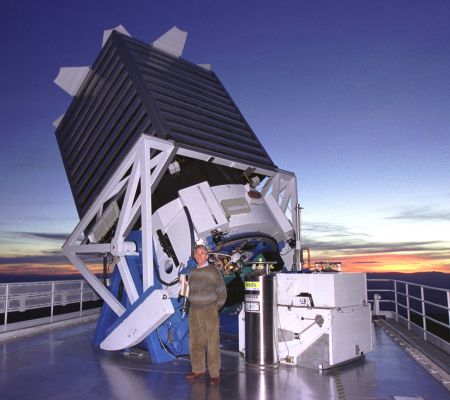
John Peoples, then SDSS Director, and the Sloan Digital Sky Survey Telescope
Sloan therefore changed things so GM’s car manufacturers actually had to buy its needed components from GM’s internal suppliers. Now if Delco made a better cheaper product, Delco’s finances would improve as well as Pontiac’s. Each division’s contributions to the end product were now more clearly identified and the incentive to innovate and improve returned. GM enjoyed incredible success with this model until it was changed decades later by perhaps less-effective management than Alfred Sloan.
So how does Sloan’s approach correct the problems I stated earlier with the functional management approach? The accountability problem is addressed by increasing the visibility of each Division’s contributions to the project. The project manager or other interested overseer can readily see how each group contributed to the overall project. The project manager maintains accountability and control by having to negotiate for her needs with each external division head, essentially issuing internal contracts to provide needed project services. As a result, the miscommunications and handover issues that happen when project responsibility passes from one division to the next disappear because these interfaces are forced to be better-defined in the more formal relationship between divisions. Information transfer might still be lacking, but if the divisions are separate enough, that may not be a problem.
Is Sloan’s GM an appropriate model for Gemini? While perhaps a viable model, it is probably not the most appropriate. Too much time, and too much cross-disciplinary expertise would be needed to properly specify the requirements for external division work. Currently, we make use of the skills that exists in other divisions to help establish the needs and requirements of our projects. To adequately scope a statement of work for the electronics component of a project would likely require more engineering expertise than Development has, for example.
A twist, then, could be to have each Division responsible for determining their own set of requirements, covering the aspects of the project for which their skills are needed only. An internal virtual contract would then be let and each Division would control their own work. In the end, though, this twist ends up being very similar to the semi-functional approach we have now. Overall project accountability remains diffuse.
So what about the successful Gemini integration of Flamingos-2? While the verdict is still out on the overall success of this instrument (it is still undergoing on-telescope acceptance testing), its integration into the Gemini environment has to date gone quite smoothly. Part of the reason for this success was the relatively early involvement of Engineering and Science in the Development project. Another was the dedicated effort each functional team invested to make sure their part of the project was successful. A clearly functional effort, is this the model for Gemini? Functional accountabilities with early involvement? A pseudo-matrix management approach?
Perhaps. Or perhaps we could evolve a bit more and continue to blend responsibilities and roles in a more matrixed approach. I think the Flamingos-2 functional approach can work, but I feel there’s more potential for true high efficiency with the matrixed model. Teams working together with joint accountability seems the higher efficiency model, although it is certainly not the only possible successful one. On the other hand, if you happen to own a Pontiac, you may be wishing for a return to Sloan’s GM.
While working for the Sloan Digital Sky Survey, Scot started researching Alfred P. Sloan, his years at GM, and the origins of the Sloan Foundation. He was always amused when Hirsch Cohen, from the Sloan Foundation would introduce himself as being from the “other Sloan”. He is still amused whenever he has the opportunity to use facility plumbing manufactured by the (unrelated) Sloan Valve Company. He also views John Peoples, pictured above, as an incredibly effective manager who brought the SDSS through some very tough times by careful use of the right management tool at the right time.
We’ve been thinking about ways to improve the instrument development process at Gemini lately, so I started to think about our management style- matrixed or functional? ….
Gemini describes itself as a matrix management organization – where cross-divisional project teams lead and complete their projects together. This approach is in contrast to one of functional management, where divisions take care of their own projects, communicating with other divisions through their Heads, only when necessary. In the matrix management case, employees are functionally managed by their Division head, but operationally, they report to multiple project managers as well. In the functional management case, employees report to their Division heads and inter-divisional coordination happens at the management level only. Management is functional, not operational.
While most Gemini internal projects employ resources from more than one functional area, suggesting a more natural matrix-management model, they are in fact managed quite functionally. Requests for exo-divisional resources are made in the planning process, approved by Division heads, while task management and project definition are often separated along divisional boundaries. Projects like new instrumentation get divided up into Development (deliver an instrument to the Observatory from the vendor), Engineering (prepare Gemini to receive the instrument and manage acceptance testing), and Science (prepare Gemini to operate the instrument and manage commissioning). Non-Development resources are being assigned to Development projects, but their tasks are often being managed by their functional division, not by the project. To me, what I just described is functional, not matrix, management.
To be fair, Gemini’s approach is at least partially matrixed. Development, for example, does employ one software division employee, functionally managed by software, but project/operationally managed by Development. When Development made this change, we immediately improved our ability to make our software deliveries. A contrary example, however, is the software integration of Flamingos-2, which was successfully handled in a more functional style.
First light image from Flamingos-2 at Gemini South.
One strength of our apparent functional approach is it gives ownership and accountability of each aspect of the project to the division doing most of the work. One disadvantage is there is no one person or division accountable to the Director for the project’s overall success. Another disadvantage is that where there are boundaries and hand-offs, there are often miscommunications and unclear procedures. Finally, any internal expertise gained by the first division in a project is essentially lost when the project is handed over to the next division.
If we really are to become a matrix-managed organization, we need to start breaking down the barriers that exist between divisions and increase communication between project managers and Division heads. Although individual project managers may not have the hierarchical authority to command resources external to their own division, they share a common goal within the Observatory to have a successful project and can realize this success by involving division heads and assigned resources in forming their project plans. If a single person is held accountable for the success of each project, it is up to that that individual to obtain the needed resources, or go back to the Division head for help, if necessary.
In a true matrix-managed Gemini, resources assigned a project would report to their own Division head for functional support, but to their project managers for operational support. Meanwhile, project managers should hold regular status meetings with their stakeholders, including the relevant external Division heads and managers. These meetings and progress reports will help the external managers feel comfortable that their resources are being properly employed and build ownership for the overall success of the project across the Observatory.
Gemini can become an effective matrix-managed organization if it wants to – simply by holding project managers accountable for their project’s success, and increasing communication and involvement between divisional and project managers. We have to start thinking and working like a team and not like a collection of divisions unwilling to pin our own success on that of another.
Flamingos-2 is a multiple object near-infrared imager and spectrograph now undergoing final on-telescope commissioning at Gemini South. Its integration into Gemini has gone very well and is a testament to the hard work and dedication of both the University of Florida team, and Gemini Engineering and Science staff. The first light images are stunning and Flamingos-2 will only get better when Gemini’s Multi-Conjugate Adaptive Optics system gets installed in the coming coming years at Gemini South.
Please see my standard disclaimer in the About page.